

I’m not sure what it was like for you, but when I was at school, history was pretty dull. Who cares about all those old Kings and ancient battles?
Well, let’s put all that behind us and concentrate on something a bit more exciting. A Bournemouth-based university lecturer is attempting to capture OUR history. Ian Gwinn is conducting interviews with scooterists up and down the country to help document our lifestyle for future generations to study.
Here’s what he has to say…

A social historian’s journey into scootering, ska and soul
As my Nan used to say, honesty is always the best policy. So, I should say from the outset that I’ve never owned a scooter, I’m not a scooterist, and I wouldn’t want to pretend otherwise. I doubt anything annoys a seasoned scooterist more than a Johnny-cum-lately telling everyone what it was really like.
I come to scooter culture from the outside, though not completely. Actually, I’ve found that I share many of the same reference points as the mods and scooterboys of the late ’70s. I watched Quadrophenia as a kid, got into The Kinks, The Who, The Jam and The Specials. I just had the misfortune of being born in the wrong decade when it seemed like all the great moments of British pop music and youth culture had already been and gone. I went to school in a parka and got laughed at. I can only remember one lad in my school year getting a scooter when he turned 16, and it was neither a Vespa nor a Lambretta.
But it’s not always a bad thing to study and write about something from a bit of distance. I don’t want to say I’ve got perspective (we’ve all got perspective!), but that I’m not invested in any one particular way of telling the story of scootering. And I think there are many stories to uncover. My day job as a social historian involves teaching students about working-class history and culture, which is gradually gaining greater recognition in the annals of modern British history. What’s striking to me is how scootering, a movement that has been part of British life for decades, still hasn’t quite received its due.
There are many important stories about 1970s-80s Britain bound up with scooters: about friendship, independence, music, fashion, class, youth, race, and the real and imagined geography of the country itself. I’ve only scratched the surface, but the more I read and talk to people, the more I realise how rich and intricate are the details of these stories. What follows are a few reflections on what I’ve learned so far.

More than a scene
Scootering shares plenty of similarities with youth movements that came before, e.g. changing fashions, obsession with music, the DIY spirit of zines, badges, patches, and flyers. But it was never a single scene. It was a big tent, open to a range of people and styles. Mods and mod revivalists, punks, 2-Tone rudies, skinheads, psychobillies, and soulies – all found something in it.
There were tensions, of course (Vespa versus Lambretta anyone?). As has been well-documented, mods and scooterboys had gone their separate ways by the mid-80s, skinheads faced infiltration from the far right, and not everyone was overjoyed by the appearance of psychobilly or rave on the rally circuit. But there seems to have been something on offer for most tastes. The real common denominator was the scooter itself. Maybe that’s what has made it so resilient over the years. It kept adapting to people’s changing tastes and was responsive to local initiative.
For all the reach and longevity, however, scootering remains oddly underappreciated in the official story of British popular culture. There are some brilliant books, photos, zines for the faithful, but few feature films or documentaries about youth culture give it a mention. I don’t know whether this is the age-old prejudice of a media that unthinkingly labels young people on scooters as mods or yobs, or a refusal to be so easily categorised or typecast. Scootering doesn’t fit the usual pattern of rise, decline, and revival. It just kept going.

A movement without a centre
One of the most interesting things about scootering is that it has no single home. Most subcultures orbit around a creative (and urban) capital – ‘Swinging London’, ‘Madchester’, Liverpool, or Sheffield. But it seems that scooter culture was everywhere all at once.
People have told me that Yorkshire or the North is the spiritual home of scootering. Indeed, early encounters between the north and the south were important in shaping the scooter movement as a national phenomenon, but there was no centre dictating its style or direction. Local clubs made their own rules. Unheralded towns and rural counties could have thriving scenes just as much as big cities. If anything, it was the seaside resorts that faced competition from cheaper foreign holiday destinations – Scarborough, Margate, Great Yarmouth, the Isle of Wight, Morecambe – which became the unlikely hubs of a national network. It was an energy that moved from rally to rally.
Of course, there was structure: the No. 1s meetings, the setting of the rally calendar, the logistics and organisational politics that made the scene function. But the decentralised approach says something deeper about Britain itself. During a period when fractures had begun to appear in wider society as a result of economic and political crisis, scooter culture embodied a more inclusive sense of the country’s social geography, from small towns and coastal resorts to deindustrialised parts of the country. Proudly local, yet nationally connected. In a way, it reflected a form of unity that some of the larger pillars of British national life often struggled to achieve.

A way of life in a changing Britain
Britain in the late 1970s and 1980s was not an easy place to grow up in. The optimism of the post-war decades had evaporated. Industry was collapsing, unemployment was high, and politics had turned bitter and confrontational. There were riots in the cities, violence on the terraces, and bombs in hotels and shopping centres. The idea that the next generation would automatically have it better than their parents was starting to wane.
In that context, scootering was more than a pastime; it was a form of escape, of expression, and of belonging. It gave people a reason to get out of town, to see friends, to dance, to laugh, and to define themselves on their own terms.
It was also independent. It wasn’t built by record companies or fashion houses. It was self-organised, affordable (until recently), and largely resistant to commercial pressures. Rallies were not corporate events; they were communal gatherings, run by and for the people who cared.
That sense of self-reliance, mixed with collective spirit, feels deeply working-class and deeply British. It was a refusal to be told what to like, what to buy, or how to behave. It was a culture of initiative, resourcefulness, and, above all, fun.

Quintessentially British?
You hear a lot these days about ‘British values’: democracy, freedom of speech, fair play, etc. But I think scootering represents another kind of Britishness that is less celebrated. It’s one that’s wilfully independent, self-reliant, a little bit rebellious, eccentric, and gloriously impractical.
There must be some stubborn joy of doing something that makes absolutely no sense to anyone on the outside. The idea of riding 200 miles in the rain to a windy seaside campsite with only a vague sense of where you are going (and without the digital technologies we’ve come accustomed to) must sound faintly ludicrous to young people today. Throw in the great British weather and you have a recipe for chaos, revelry, and stories that get told and retold down the years and become legend.
It’s also a more global or international story than you might anticipate. Italian scooters, American soul music, Jamaican Ska, all blended and reworked in a distinctly British way. That mix of different influences has been a defining trait of British youth cultures, and scootering fits right in there, while remaining its own thing. And the influence has been exported back to Europe and other parts of the world.
Geography plays its part too. Where else could people travel from one end of the country to another in a day on an Italian shopping bike? Britain’s seaside towns, fading bastions of working-class leisure, provided the ideal backdrop for a new kind of collective escape.
Scootering, for as much as I’m still to learn, reveals something important about how Britishness was reimagined in the late 20th Century; less about empire and establishment, more about individuality, defiance, and shared experience.

Capturing a living history
The project I am working on aims to record this history, not so much to romanticise it but to recognise it as part of Britain’s cultural history and memory. Other subcultures from the era like Punk, 2-Tone, and Rave have received greater coverage in films and documentaries, but the story is often told through a handful of well-known voices. What is often missing are the people who kept things alive on the ground, day-to-day, year after year.
So, this is an invitation as much as an article. If you were part of a club or the scene, if you went on rallies, or played in a band, DJ’d, organised a lunchtime or evening do, then I’d love to hear from you. I don’t intend to tell people what they already know; I’m keen to listen, learn, and help make sure the knowledge and memories don’t get lost. I’m sure there’s plenty I’ve missed here, and some of you will say that it wasn’t quite like that.
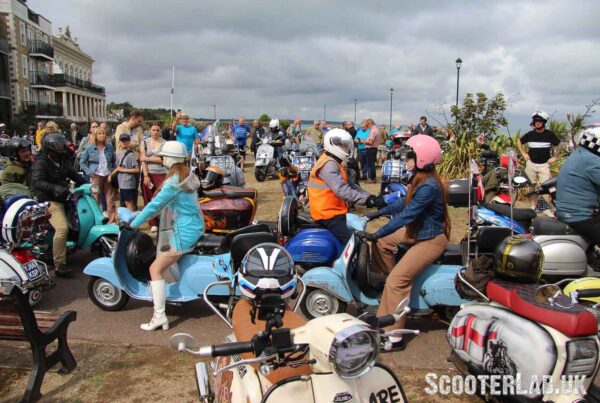
Nonetheless, I think scootering tells us something vital about who we were and who we are. A culture built not in recording studios or boardrooms, but on the roads, in the towns up and down the country, at seaside venues, by ordinary people who refused to accept what was on offer and wanted to fill the void by creating their own entertainment. It’s a living history, one that can still be seen today at rallies all over the country.
If you would like to share your memories of the 1970s, 80s and 90s and explain what scootering has meant to you, then please get in touch. I’d love to hear them. You can get in touch with Ian by emailing him at: skatellitetowns@gmail.com or by joining the Facebook page here.


Scooter Lifestyle
Thanks to Paula Turner for allowing me to use her images in this feature, some of which appear in my 2007 book, Scooter Lifestyle.
Iggy







you wrote this really well , for someone who didnt go on the national rallies or wasnt around then , i think you hit the nail on the head ,i was into the scene and went on the national rallies , loved it , then didnt , i got bored , the scene stayed the same, i didnt , moved on ,raves and free partys where way more exciting , still love scooters though , i dont have one , got bikes ,but still glad i was around at that time and what it meant, still got my ma1 jacket with the paddy smiths,means alot