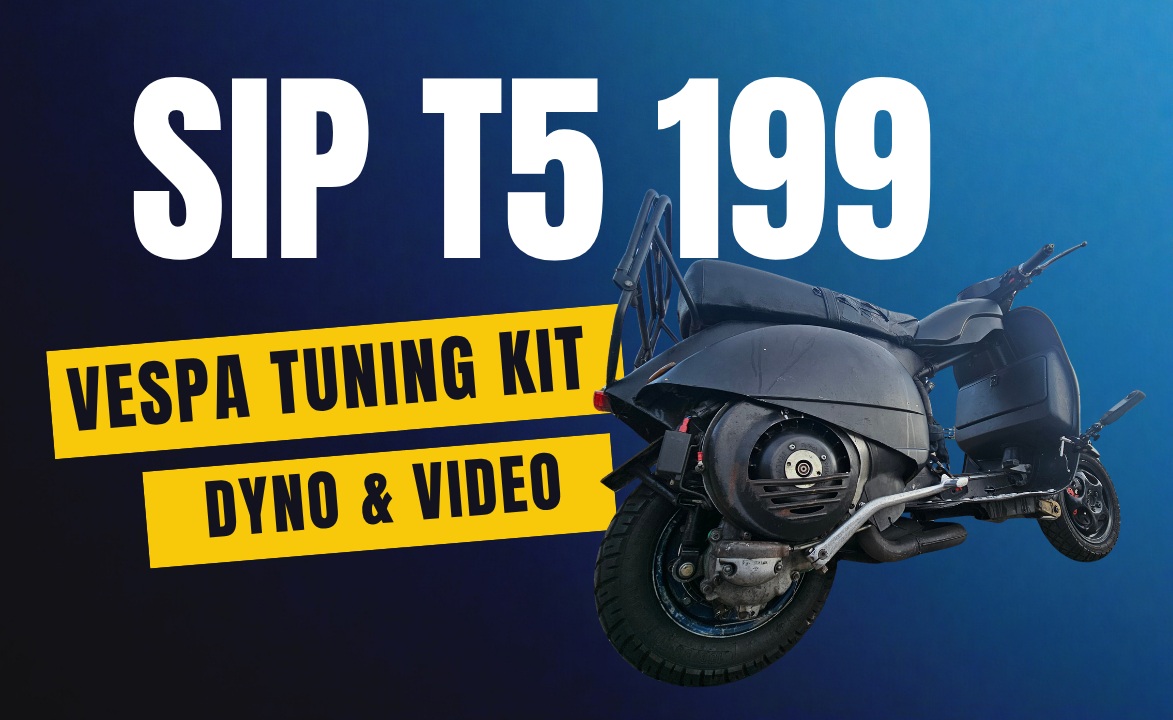

SIP Scootershop’s long-stroke kit for the Vespa T5 is out on the street. But is it better than the legendary Malossi 172? Sticky continues his investigation to help us find out…
In the last episode, J.R. woke up, and it was all just a bad dream.
No, that’s not what happened.
In the last episode, J.R. woke up from his dream and realised that modern reality was actually worse than his nightmare, and requested another coma.
No, that’s not right either.
In the last episode, we assembled the SIP T5 199. Once you understand it can’t be fitted to a standard T5 engine with the original crankshaft, everything is straightforward. Look at our Part 1 article and video for more information.

Modified White One Racing RPM exhaust with welded-on T5 stub (left) versus SIP Road 3 (right).
Bodging an exhaust
The first exhaust we tried was the White One Racing (W1R) RPM box for the PX125. We have an exhaust stub adaptor to allow PX exhausts to fit onto the T5 cylinders, but note that the angle of these isn’t correct, and none of the PX box pipes fit very well. You might get away with using PX expansion chambers on T5 adaptors if they have slip joints in, but they don’t work well with box exhausts.
In frustration, we cut the Vespa T5 flange off an old expansion chamber and welded it to the W1R box to get on the road.

If you have an air compressor, then it’s easier to swap exhausts by deflating the tyre than removing the rear wheel. The fat rear tyre on Dreadnought requires a G-clamp to get it out of the way of the exhaust bolt.
Why did you start with an exhaust that wasn’t even for this engine?
That’s a good question. The answer lies in the fact that I had one on the shelf, in good condition. The second answer is that we have dyno graphs from this very engine when it was a 172 and we fitted the W1R RPM exhaust for an article.
Therefore, we would be able to produce as close as possible to a like-for-like pair of graphs on the same engine with only the kit changed. At least that was the theory…

Dreadnought is still on autolube. We hope to test some of the clever bellmouth solutions for SI carbs in the future.
For both tests, the spec is:
- Standard casing with ‘cleaned’ inlet port
- Standard 24mm SI carburettor without a filter; instead, a foam filter is mounted to the front of the airbox on a hose
- LML BE3 atomiser (this is a totally different hole layout to the Dellorto BE3) which I found to work well in curing the ‘cough’ as you re-open the throttle on the 172. For the dyno test this was fitted with a 130 main jet
- An uprated oil pump drive gear. I may explain more about that in the future, but it allows you to run kitted engines solely on the autolube

Both of these atomisers are marked BE3, but the Dell’Orto one (left) has vastly different hole sizes and positions to the Indian one we used (right).
Changes on the T5 199 engine build:
- Previously, the engine was a Malossi 172 cylinder with a head prepared by Harry Barlow of Pro Porting. This was replaced by the SIP T5 199 in completely standard spec.
- Previously, the engine used a polished original T5 crankshaft rebuilt by Harry. This was replaced by the 60mm stroke SIP crank built by Primatist in Italy.
- Previously the engine ran a standard T5 ignition set to 18 degrees BTDC static. This was replaced by a Pinasco Flytech variable ignition set to around 23 degrees advance.
- Previously the engine used either a 20-tooth or 21-tooth primary drive gear in the clutch. Now it is fitted with a 22-tooth gear and an oversized rear tyre. Apart from that, the transmission is original.

T5 172 vs SIP 199 W1R box
What were the results with the W1R RPM exhaust?
In fairness, the W1R exhaust is not perfectly suited to the kitted T5 motor. It makes excellent low-rpm power and torque, but it signs off early. This is a box exhaust that you might want for use with a sidecar. Or perhaps with a passenger who weighs as much as a sidecar. We all know a few of those…
The graph is very useful though, because it’s a like-for-like comparison: only the kit and crank have been changed. The 199 kit is better everywhere and it is better by a significant amount. At 7,000 rpm, it’s 4hp better, which is around a 28.5% improvement. That’s huge, and unlike normal 2-stroke tuning, where you expect there to be a trade-off somewhere in the rev range, there isn’t one. It’s just better.
The problem with the W1R exhaust was on the road. The low rpm punch with so little over-rev meant that it was pleasant to ride and pulled every gear, even up hills, but it had lost its unique T5 character. It felt more like a quick PX200 than a rev-hungry T5. It was too much Clark Kent and not enough Superman.
The problem was that the exhaust didn’t really suit it, so SIP sent me an example of their latest T5-specific box: the SIP Road 3.
VIDEO | Road testing
Cooking with gas
With the SIP Road 3 fitted, the engine suddenly came alive and behaved like a T5 ought to behave. Power delivery is linear, so the higher the revs, the faster it feels. Suddenly it’s fun to ride again. It retains the soul of the T5 (and the Malossi 172), but with a chunk more top-end power than before.
Sadly, I didn’t get much chance to ride it far before I had to leave the country and give the scooter back (my son now owns it), so I can say nothing about the fuel economy or long-term reliability of the kit. These are things that only the fullness of time can reveal. However, I have friends in Germany who’ve already bought and fitted these kits and put plenty of miles on them without bother, so the omens are good.

Exhaust choices
These three curves show the SIP 199 kit on the same engine with a selection of exhausts. The SIP XL (green) doesn’t suit it. It makes the worst power and torque of all three boxes. Its only positive is a willingness to really rev high. The W1R RPM (red) makes the best torque and decent power, but the party is over as soon as it has begun. A peak output of a little over 18hp isn’t bad, but it misses the soul and excitement of the T5 engine. By contrast, the SIP Road 3 (blue), at a little over 20hp, makes for a linear power delivery and an entertaining ride that keeps the essence of what made the T5 engine so unique in the Vespa range.

The question of value
This is the point where opinion takes over from fact. Like politics, purchase is often driven by the heart more than the head.
At €470 (around £400), the 199 costs only a little more than a Malossi kit, yet it comes with a cylinder head, whereas the Malossi does not. In terms of value, it is at least as good as the ‘old master’, if not a touch better.

Don’t forget your crankshaft!
The sticking point is that you need a dedicated 60mm-stroke crank to utilise the SIP kit. That adds another €368 (around £310) for the forged-rod version of the crank, plus the cost of bearings, gaskets and seals. As a home-build upgrade with a new cruciform, a new box exhaust and maybe a primary drive rebuild, you are looking at maybe €1,000* in spend.
*Note: I’m quoting prices in Euros because they are fixed, including VAT, in the EU. If you buy from the UK directly, you will see lower VAT-exclusive prices on the SIP site, but will pay duty on import, which brings the price you actually pay back to broadly the same. If you find that too confusing, then you can alternatively buy SIP parts from UK retailers.

Is it worth it?
If you have a T5 that is sitting unused and in need of a rebuild anyway, then this is a good way to get more performance easily, while keeping the soul of the T5 intact. It rides, sounds and looks like a more powerful standard T5, with only the cowling spacer to give it away.
If you have a Malossi-kitted T5 that works fine as it is, then you have to just decide whether you want to spend this much to improve it. Maybe wait until it needs a rebuild next time and do the upgrade then.
If you are a T5 rider who simply wants to have the latest and greatest, then here it is. The SIP T5 199 gives you more of the same. It’s more powerful throughout the rev range while retaining the practicality of the original and keeping the T5 ‘Pole Position’ spirit alive.

21% power gain
This graph compares the Dreadnought engine as I raced it over the Alps (Malossi kit and Taffspeed Mk4 exhaust in Red) versus the SIP T5 199 engine (Blue). Peak power is up by 3.5hp, which is roughly 21%. The power and torque curves build progressively with no untoward lumps and bumps. If you liked it before, then this is an obvious improvement, and yet it comes with the convenience of a box exhaust that is still relatively quiet but doesn’t present any challenges to ground clearance or rear wheel removal.
Conclusion
Is there more power to be found in the T5 199 engine with further tuning?
Oh, for sure there is, but I don’t think we’ll be hunting for it. If I wanted a really powerful largeframe Vespa, I’d be heading down the route of different casings and a 244cc+ dedicated engine build.
But that’s not what this is, in my opinion. The 199 kit seems more like the same practical daily-driver engine that you always loved, but 20-something percent better all round. That’s not enough performance to make it a GTS beater for long-distance rallies, but it certainly closes the gap a little while remaining much more characterful. If you keep your expectations realistic, rather than being caught up in some of the online hype, then I don’t think you’ll be disappointed.
With this kind of power delivery, it’s easy to remember the fun of a 2-stroke engine paired with a manual gearbox. This is analogue enjoyment in an increasingly digitised world.
Sticky