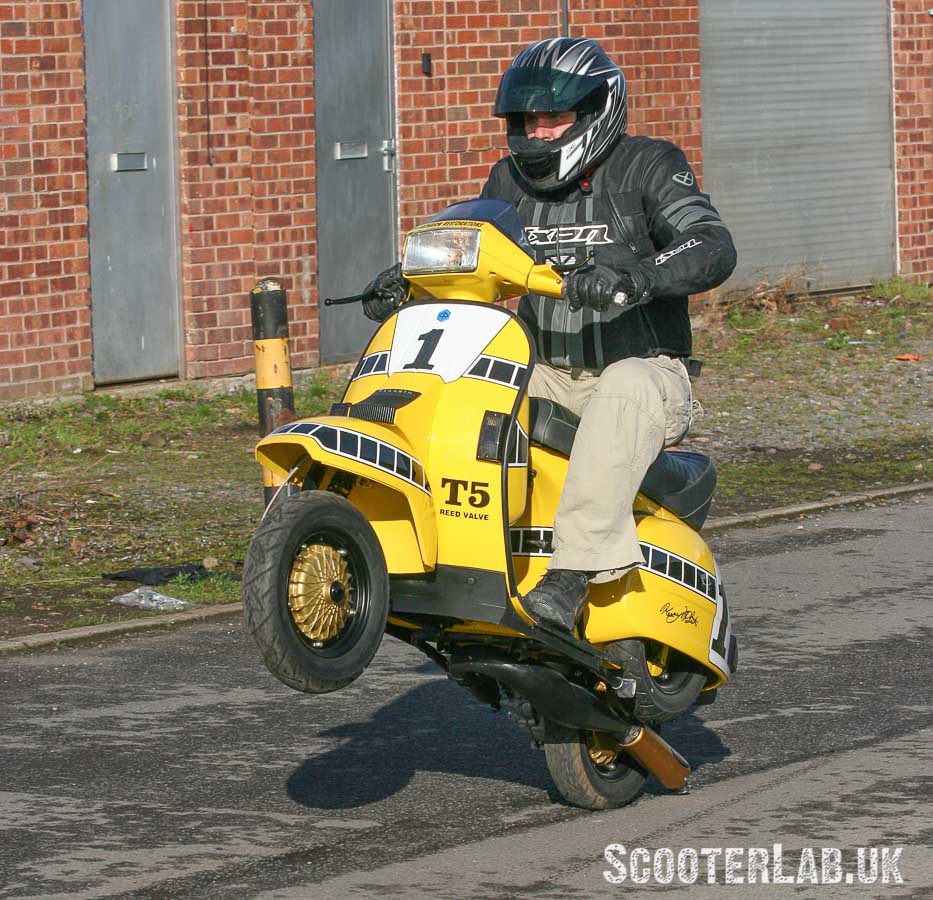

My old T5 ‘Dreadnought’ has survived non-stop races over the Alps and being fitted with Nitrous Oxide for magazine articles.
It’s now being dragged out of retirement, like Bruce Willis for Die Hard 18: Now, where did I put my keys?
Vespa T5 riders are a particular breed. Back in the 1980s, they were willing to overlook the visual challenges of the Mr Blobby headset design and square back end in a quest for power. In 1985, this meant a 125cc that was, in many instances, quicker than the ‘big’ Vespa PX200. A learner-legal scooter that was fast enough for long-distance rallies and powerful enough to carry a passenger.


Mr Blobbio?
Rumour has it that the T5 was designed by Italian genius Vittorio Blobbio, who Piaggio headhunted from British Leyland after his fantastic styling of the Austin Montego.
Bolt-on power
When Malossi introduced the 172cc kit, the T5 became even better. You could literally bolt on extra power. With a kit, an exhaust and maybe a bigger main jet, you had a scooter that would approach 70mph downhill and, in ideal conditions, stay flat-out for hours.
The best large frame engine?
For me, the Vespa T5 engine combined with a Malossi kit was the best large frame Vespa engine available. That’s why, when I wanted to build a scooter for long-distance Cannonball Runs around Europe, it was the configuration I chose. Just a Malossi 172cc T5 with a standard carb, uprated oil pump, Taffspeed Mk4 exhaust and a radical hub-centre-steered chassis that carried 18 litres of fuel. With that spec, you could ride with the throttle pinned for 170+miles before you needed to stop.

A simple Formula
Simple method to carve an elephant: get a giant block of marble and chip away everything that doesn’t look like an elephant. To make a hub-centre steered Vespa: add one third of an Italjet Formula and weld to Vespa. Both recipes sound simpler than they are.
I wasn’t wrong. With Dreadnought I won every Cannonball race I entered: From Munich in Germany to Pordenone in Italy over the Alps (with Harry Barlow on another tuned T5) in 2002, and once again around Holland. The Malossi T5 was simply the best tool for the job.
Then, for decades, T5 kit development halted. The Vespa GTS arrived and, for many maturing Vespisti, the T5 ended up relegated to the garage for occasional use.

The typical T5 rider: usually an accident waiting to happen
Who rides a T5?
I see the average T5 rider as someone who wants the best-performing 2-stroke Vespa that they can own, without sacrificing comfort or convenience.
Sure, you can get way more power out of a smallframe with any of the new breed kits. Yes, you can get much more power for your T5 if you swap the engine for one of the latest PX engine cases from Pinasco (see our 8-part engine build series here), Malossi or Polini and build an engine of 244cc or more with a kit from the likes of Quattrini, Malossi, Polini or VMC.
Very inconvenient
All of those aforementioned options require the breaking of not just your piggy bank, but maybe even a few bank accounts. By this stage, with a new breed smallframe or largeframe, you have usually lost the convenience of easy starting, oil injection, and acceptable fuel consumption.
Basically, you have removed all the conveniences that made the T5 appealing in the first place.
The unicorn
For me the beauty of the Malossi 172 kit is that it was pretty much ‘plug and play’; with the exception that they didn’t supply a suitable cylinder head with the kit when it was launched.
What would be really perfect is if someone could bring out a better kit that still ran with all the standard carb and oil pump* components, but bettered the Malossi kit throughout the rev range. That would be spiffing, wouldn’t it?

The SIP solution
SIP have thrown their ‘hat’ in the ring with a solution that meets that specification, in part by ‘cheating’. The SIP 199 kit should be able to beat the Malossi, not only on porting that was designed 40 years later, but also on the fact that it has a bigger capacity.
The 65mm bore diameter is unchanged vs the Malossi kit. In fact, the pistons are remarkably similar, to the point where I suspect you could fit a Malossi piston to a SIP kit if ever required. What is different is the crankshaft stroke. The original crankshaft has a 52 mm stroke, but the SIP kit requires a massive 60mm stroke crank, which is what raises the capacity to 199cc.

SIP’s lovely 60mm stroke crank by Primatist is a work of art
Wow, a T5 200. That’s what people started asking Piaggio for in 1985, and it’s only taken 40 years to get what we wanted…
Look at my long rod
There are pros and cons to the SIP solution:
PROS
- It raises the engine capacity – an easy way to make more power
- It uses a high-quality crankshaft made by Primatist in Italy
- The crank fits (almost) straight into the original casing
- The SIP kit can still run with the original casing and even oil pump, if you are brave
- It’s probably a good idea to upgrade your old crankshaft anyway when fitting a new performance kit
CONS
- Longer stroke requires a longer cylinder
- The longer cylinder requires longer studs (not supplied) and an adaptation of the original cowling (not supplied)
- Rather than simply fitting a kit to a standard engine, you are now fitting a kit and a special crankshaft, which obviously adds quite a lot to the cost of the conversion
- Fitting a new crank also requires a full engine strip-down, which is far more work than the Malossi 172 upgrade
TOP TIP
Splitting and rebuilding a large frame Vespa engine is not that difficult, and there are tons of reasons why it’s a good idea if you are fitting a kit. Firstly, it gives you an opportunity to rebuild the primary drive and renew the gear selector cruciform, both of which should be regarded as service jobs. Rebuilding the primary drive also provides the opportunity to adjust your gearing (depending on exhaust, the 199 engine will pull taller gearing). Finally, a new crankshaft also means renewing the main bearings and oil seals. Again, these are prone to wear, so an excuse to renew them is a good thing.


You can see where the casing needs to be relieved for con-rod clearance with the 60mm stroke crank.

It was a pain to discover this only after the engine was fitted with bearings, so we had to mask everything to protect it from filings while grinding.
Kit fitting video:
The accompanying video covers most of the problems that you are likely to come across on a build of the SIP T5 199. Most of the gaps in the process come from the fact that important information is housed in disparate locations, from the supplied micro-manual to the website listings for the kit and the crankshaft.

You can translate the German manual using a smartphone camera
Essential shopping list
- SIP T5 199 kit: £326; which includes cylinder head (# 1804000N)
- SIP 60mm stroke crankshaft by Primatist: £255 (#45106600)
- Longer cylinder studs: £5.63 (# PI829375)
- A cylinder cowling spacer for longer barrels: £33.48 (#23328500)
UK buyers see the ex-VAT price on SIP’s website. VAT/Duty and handling charges are added before delivery.

This is the BFA solution to spacing your cylinder cowling

It’s easy enough to make your own if you have some sheet steel or aluminium and some tin-snips

Just a little deburring required…
Also required:
- New crankshaft main bearings and oil seals
- New gasket set
- A strong clutch with maybe a 22-tooth drive cog
- A set of larger main jets
Apart from discovering the need to modify the engine casings for crankshaft clearance after fitting the bearings (so we needed to mask all the internals), the engine build went completely as planned:
Starting with the thicker of the two supplied base gaskets we obtained 1.5mm squish when the target is 1.45 to 1.6mm.

The engine passed its leak-down pressure test with flying colours
Ignition
The only non-standard part of our build was the choice of ignition and clutch: We fitted a Pinasco Flytech ignition for the lighter flywheel and advance-retard timing feature (with a similar curve to the Vespatronic).

The SIP instructions recommended 18 degrees of ignition timing advance, but with a Pinasco Flytech we set it to retard from 23 degrees back to 15 degrees across the rev range.

More to follow
The engine was already fitted with the W1R lightweight clutch, which we converted from a 20-tooth primary to a 22-tooth in expectation of a little bit more torque and speed.
Quite how much ‘speed & power’ is released will be revealed in the next episode…
Words photos and video: Sticky