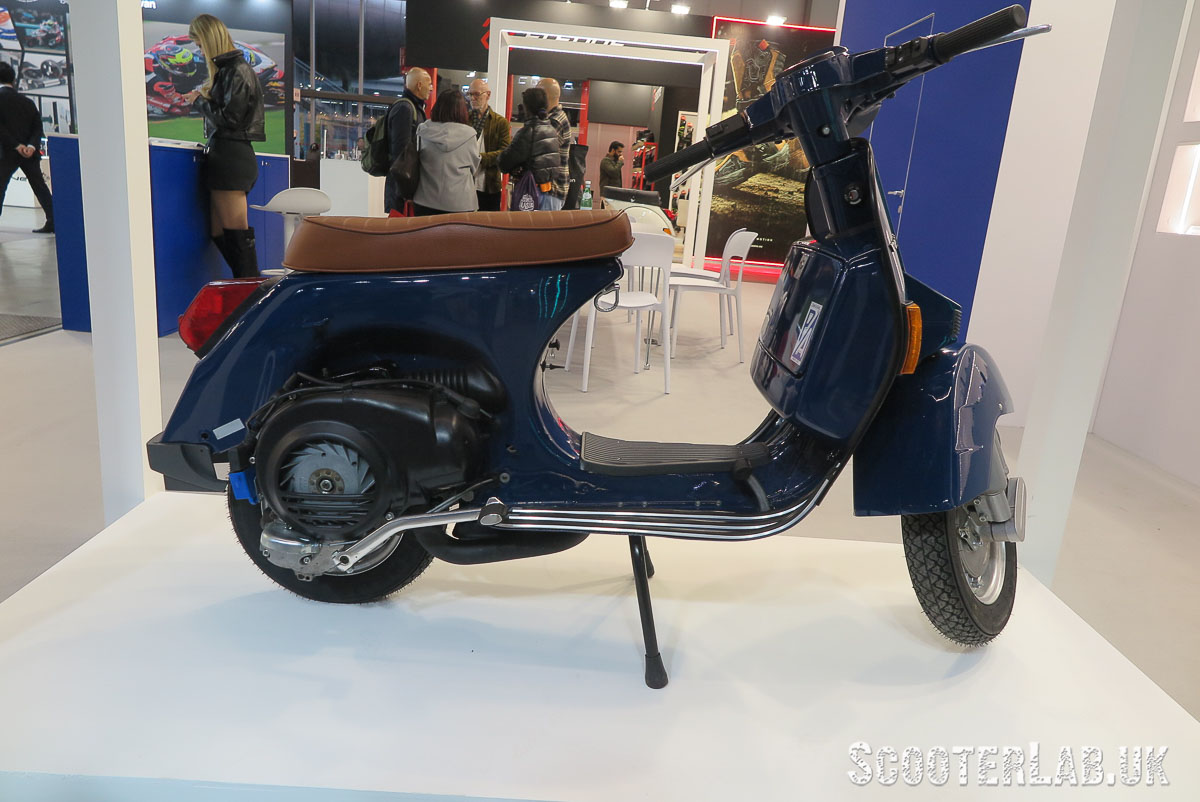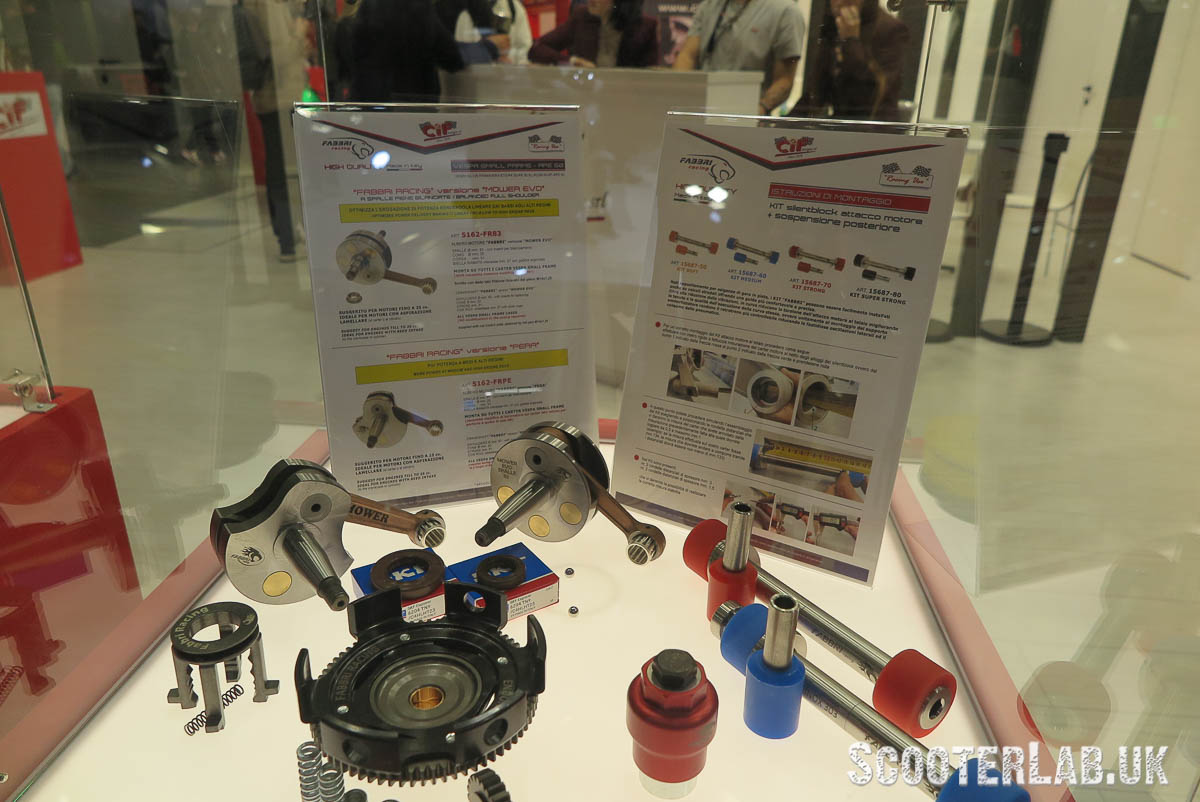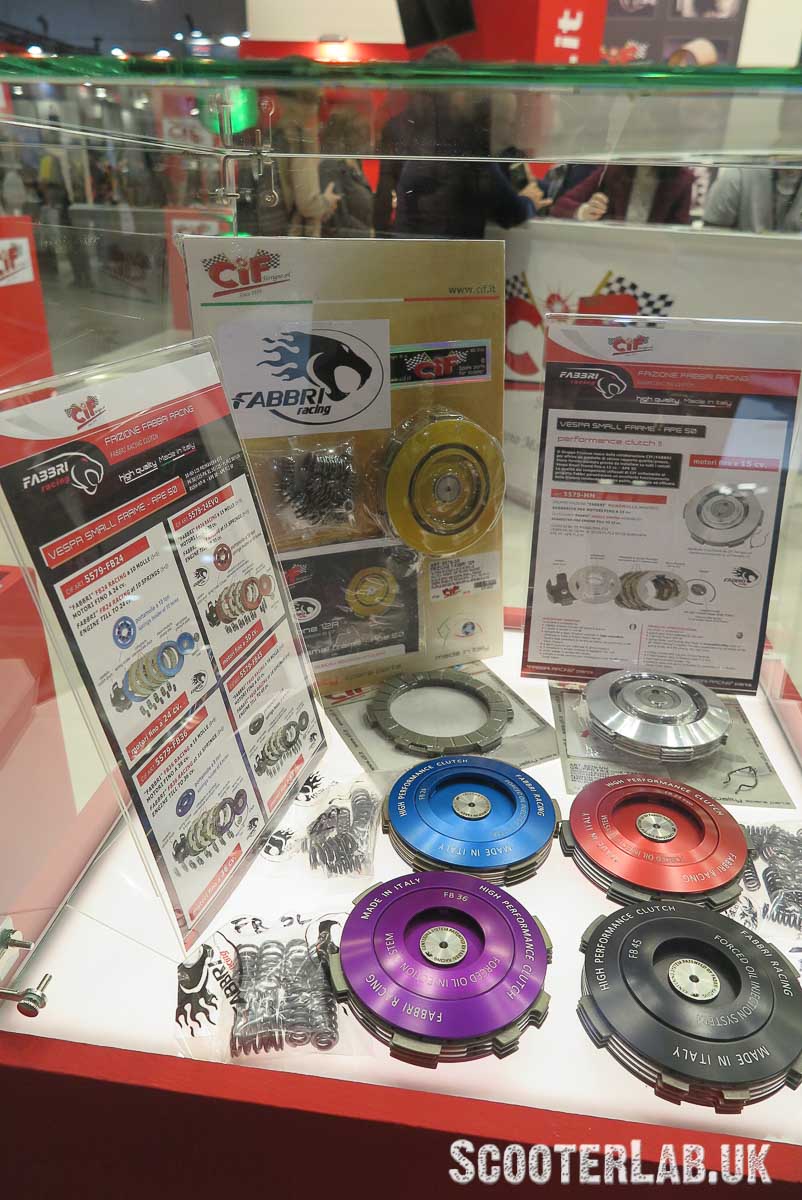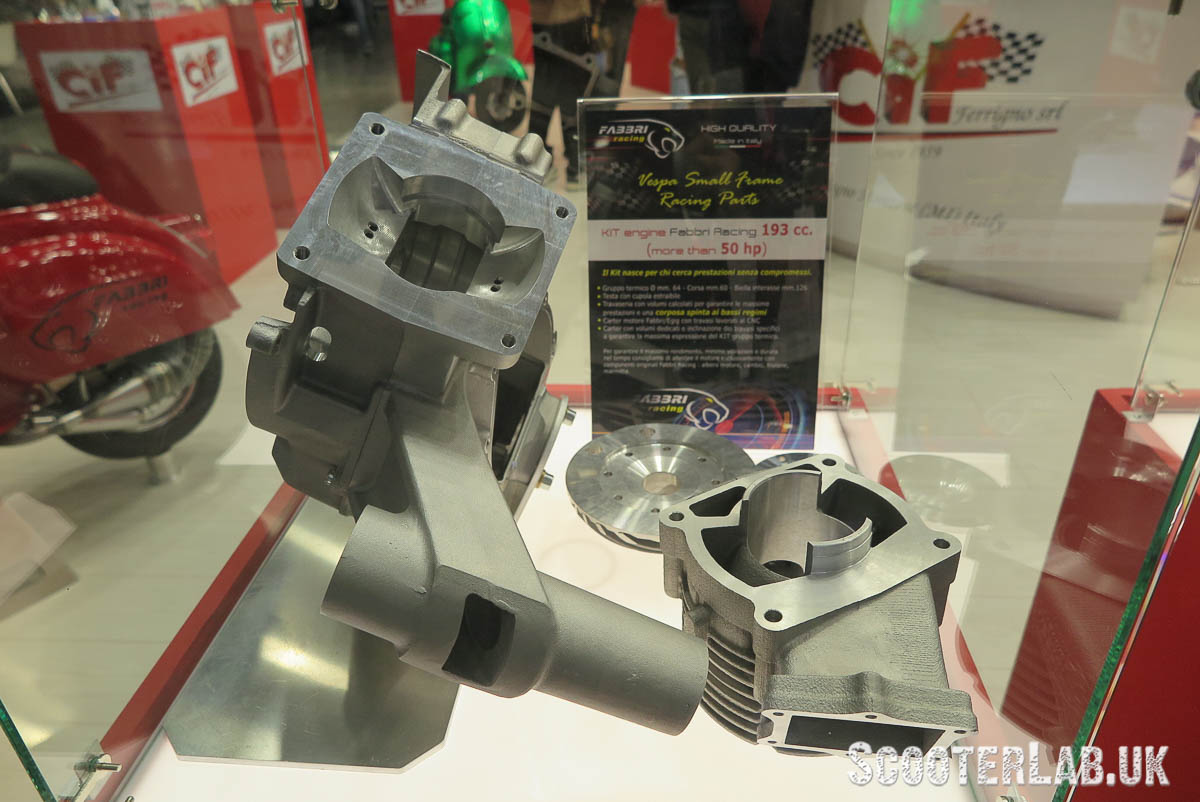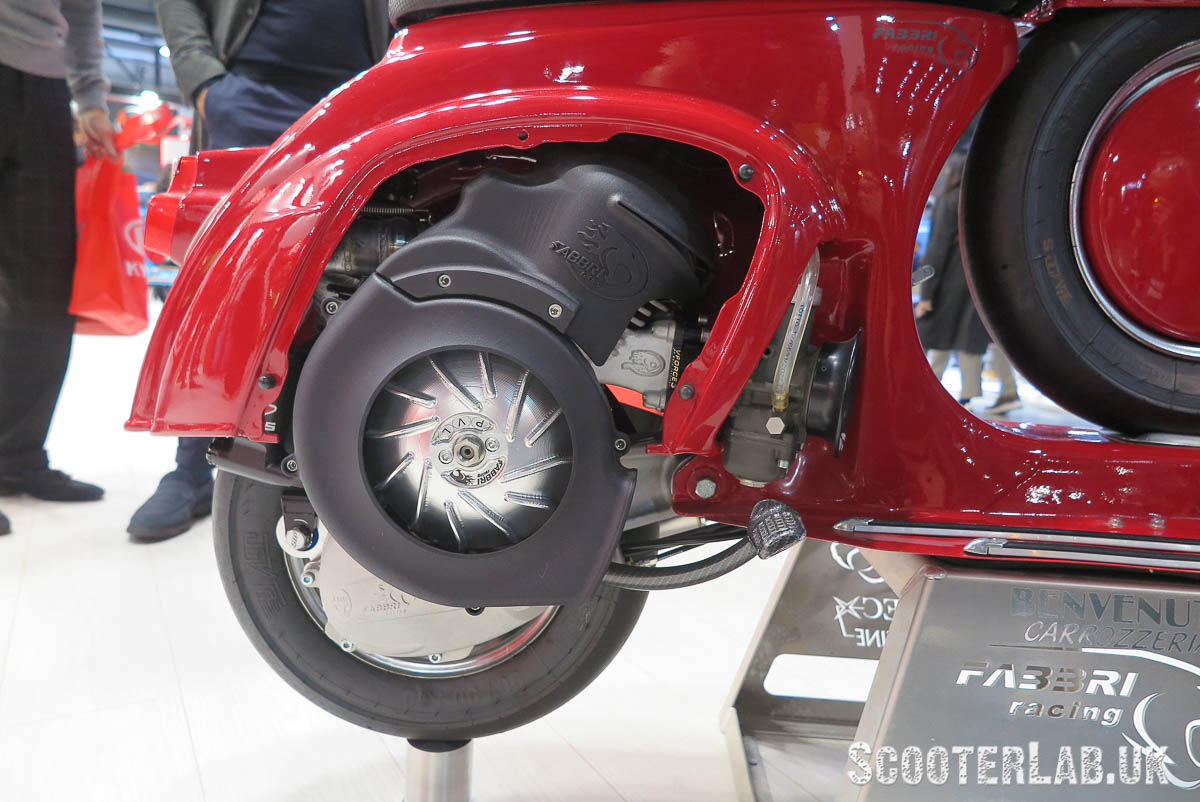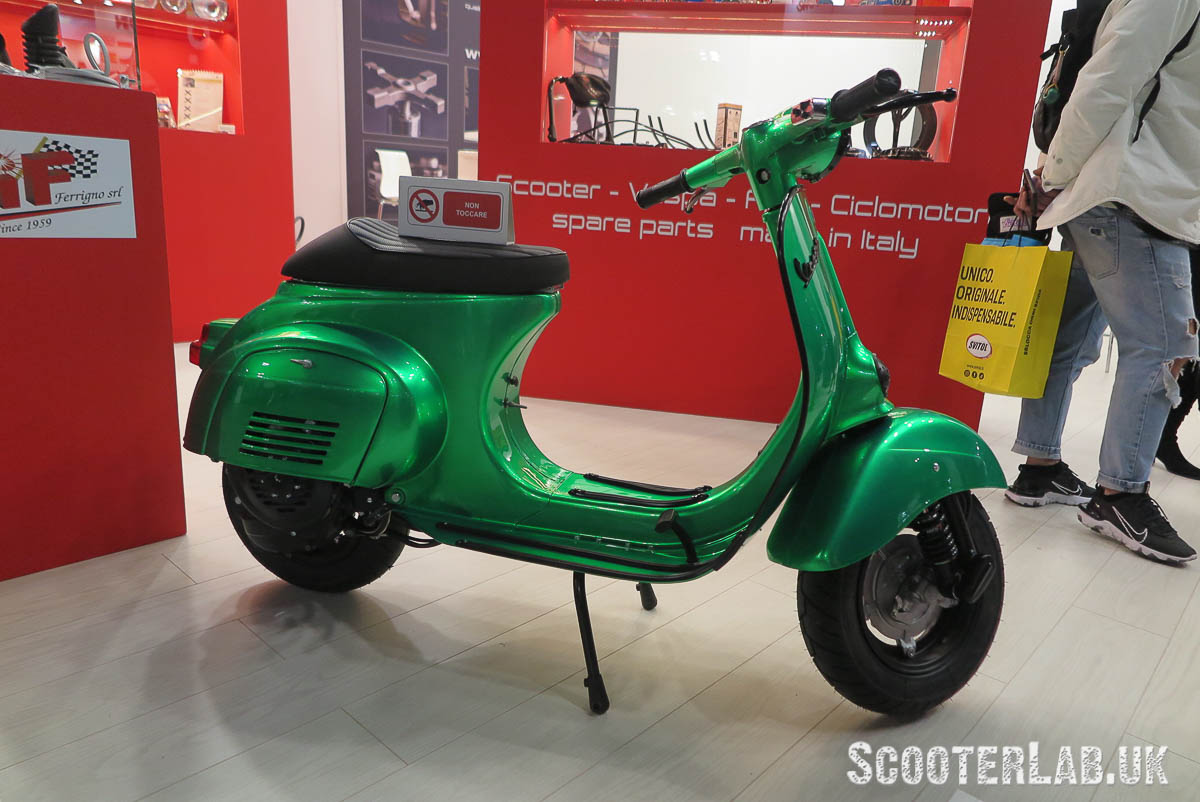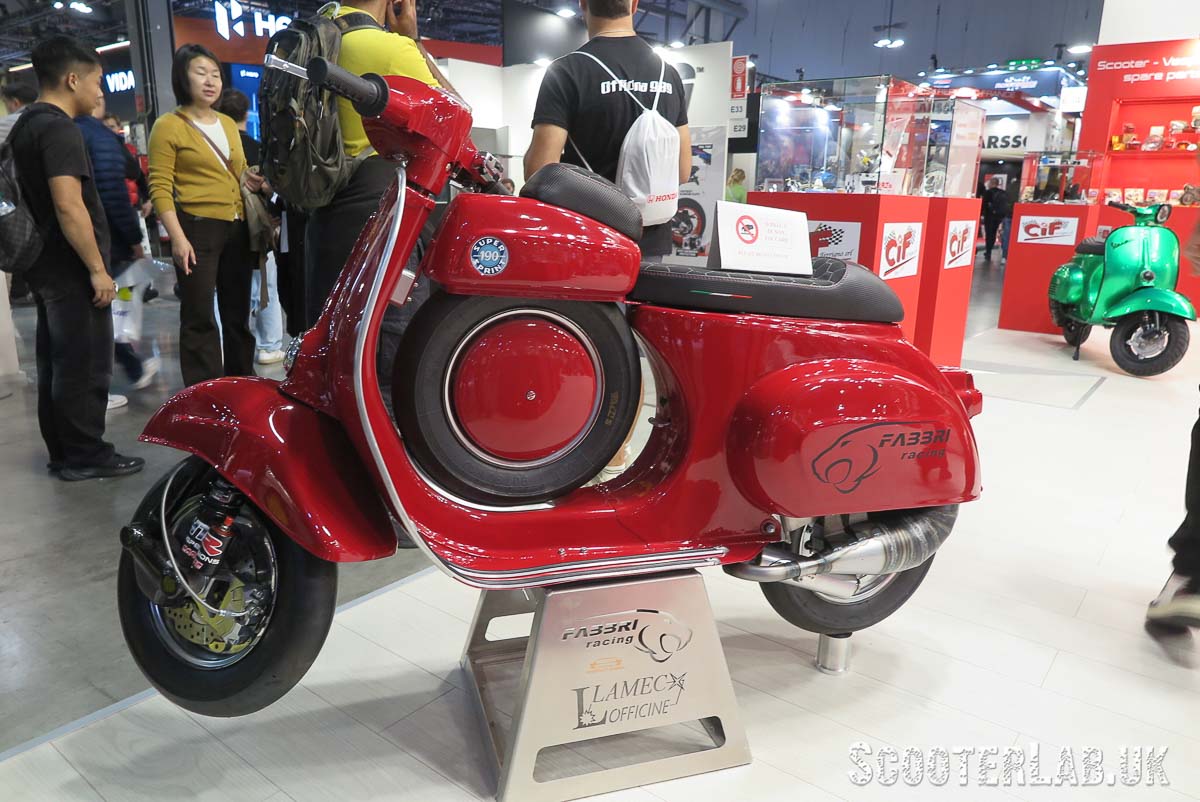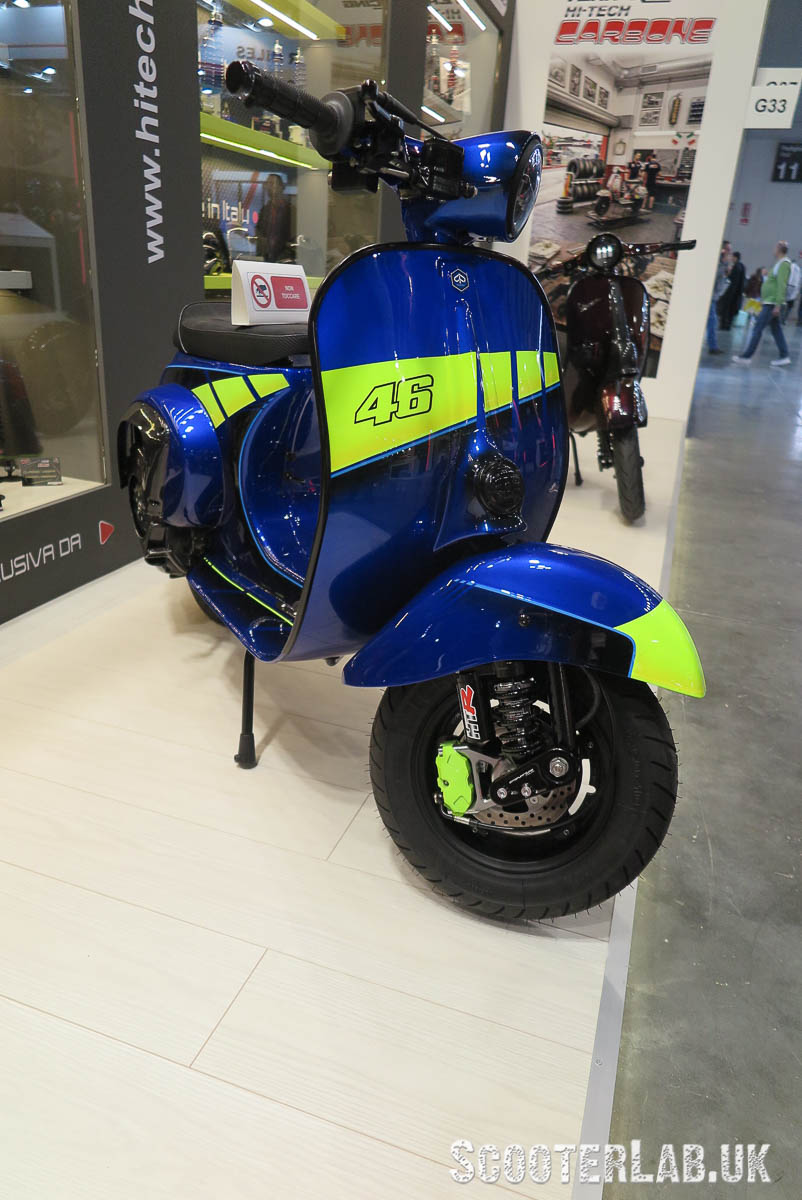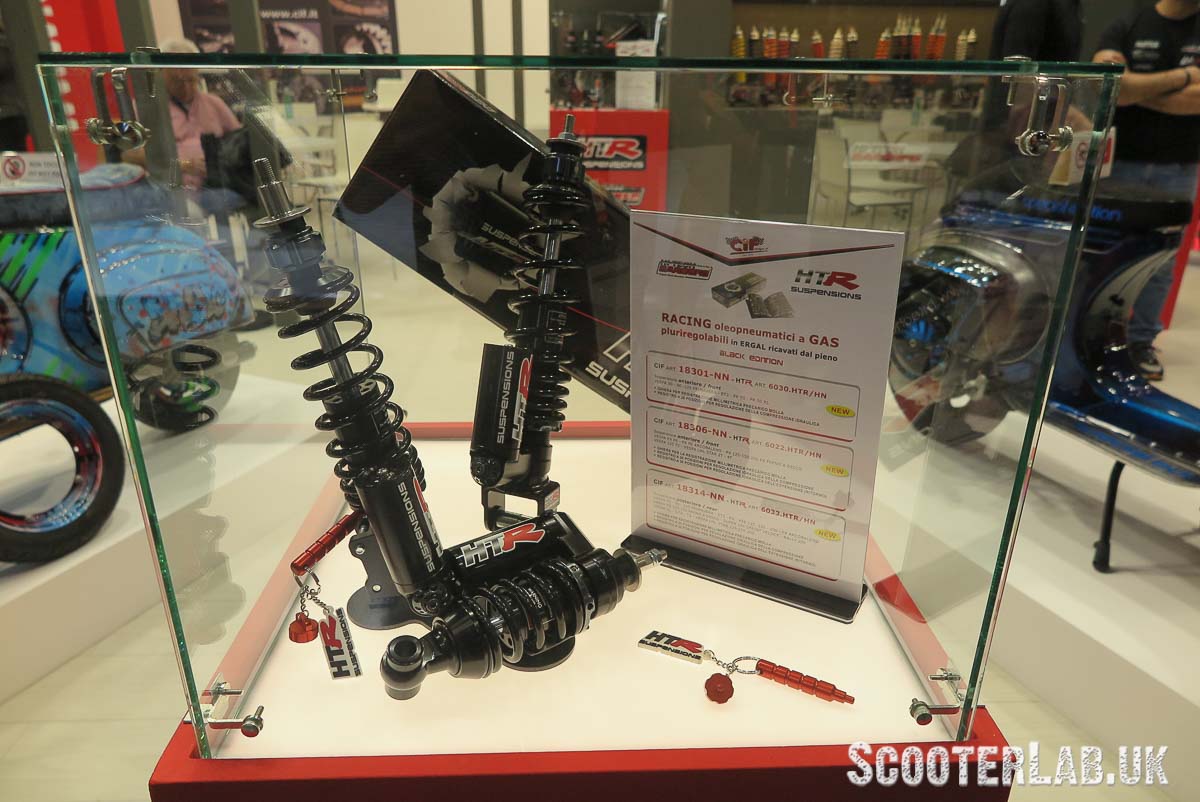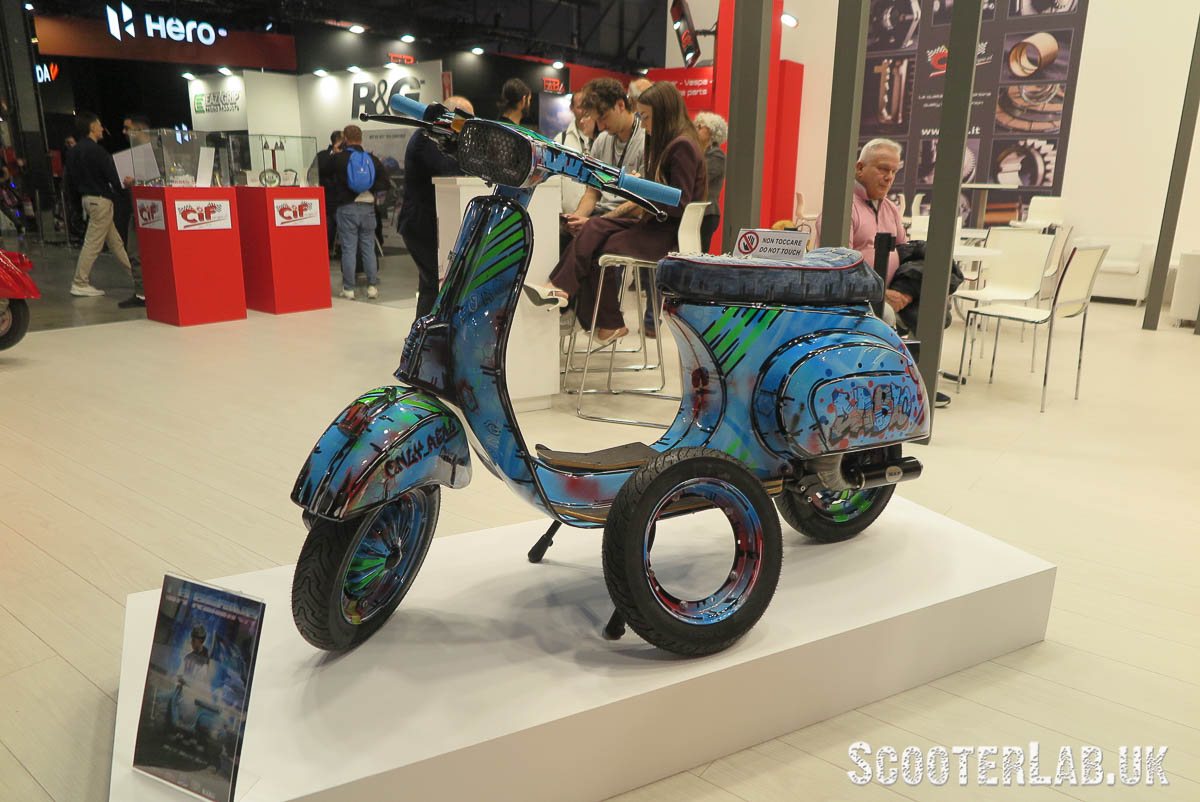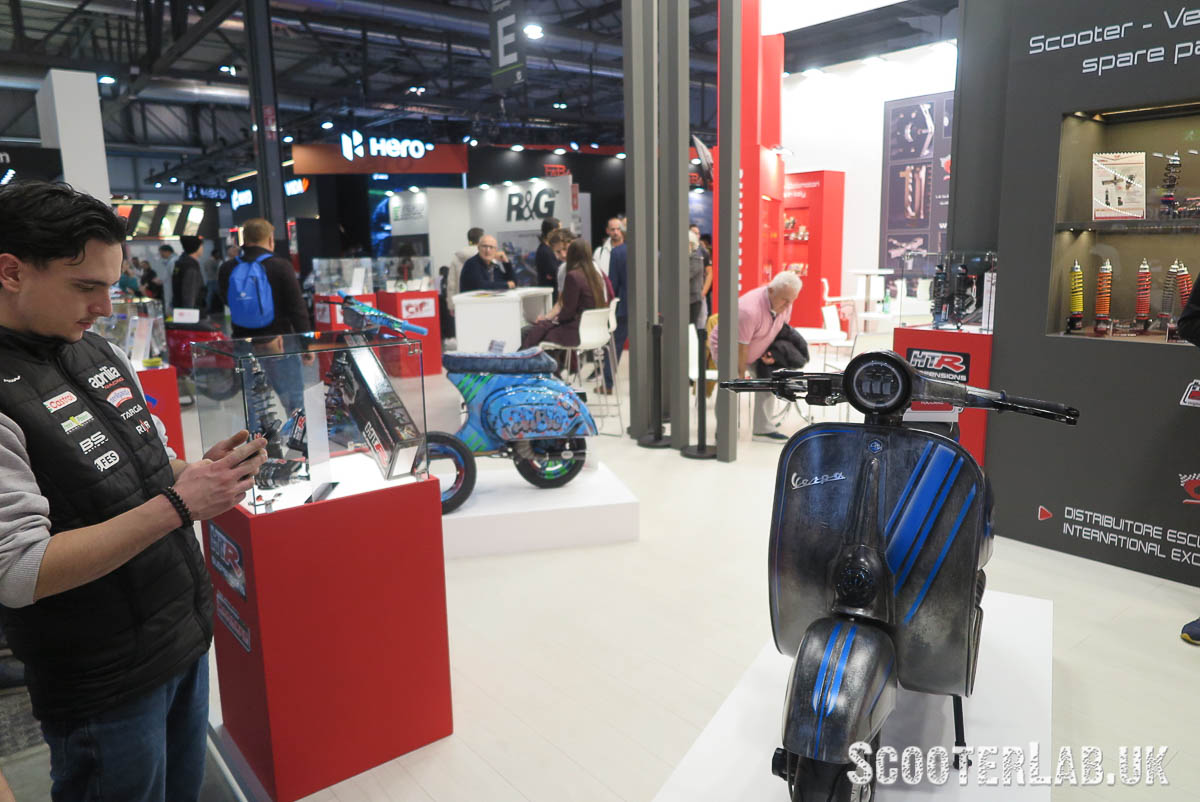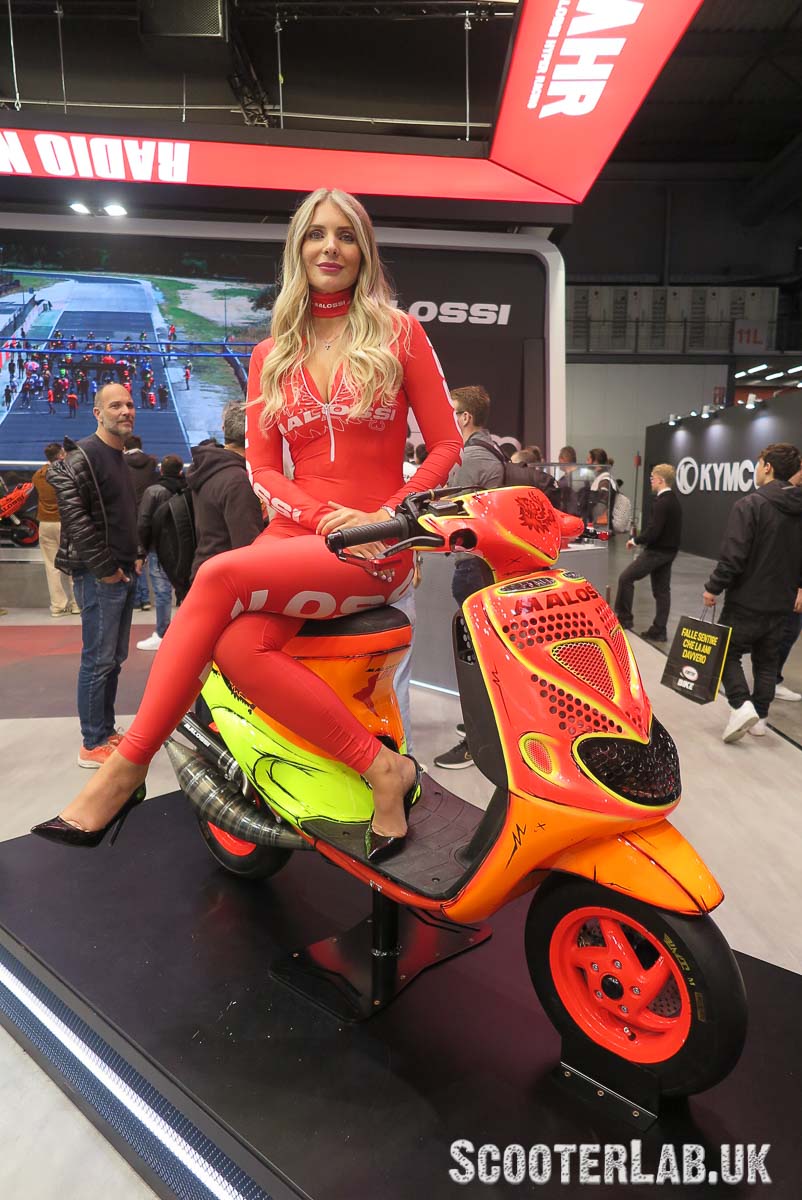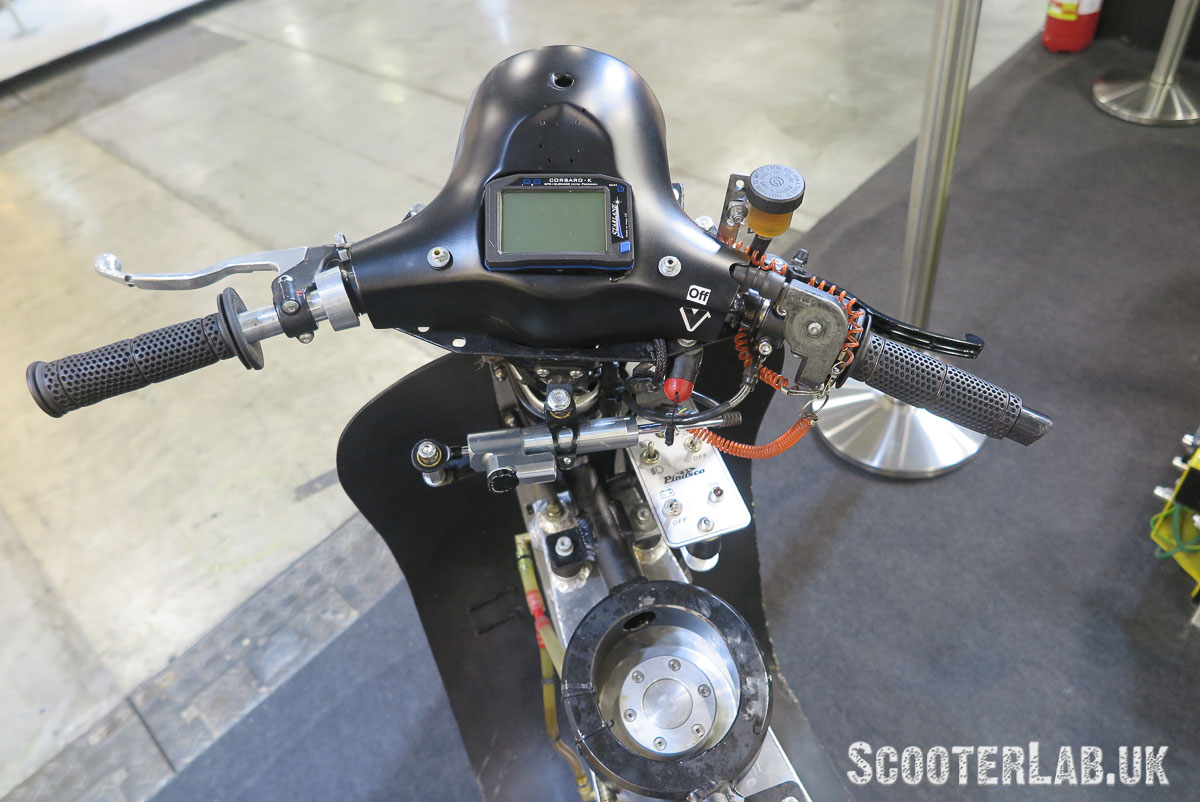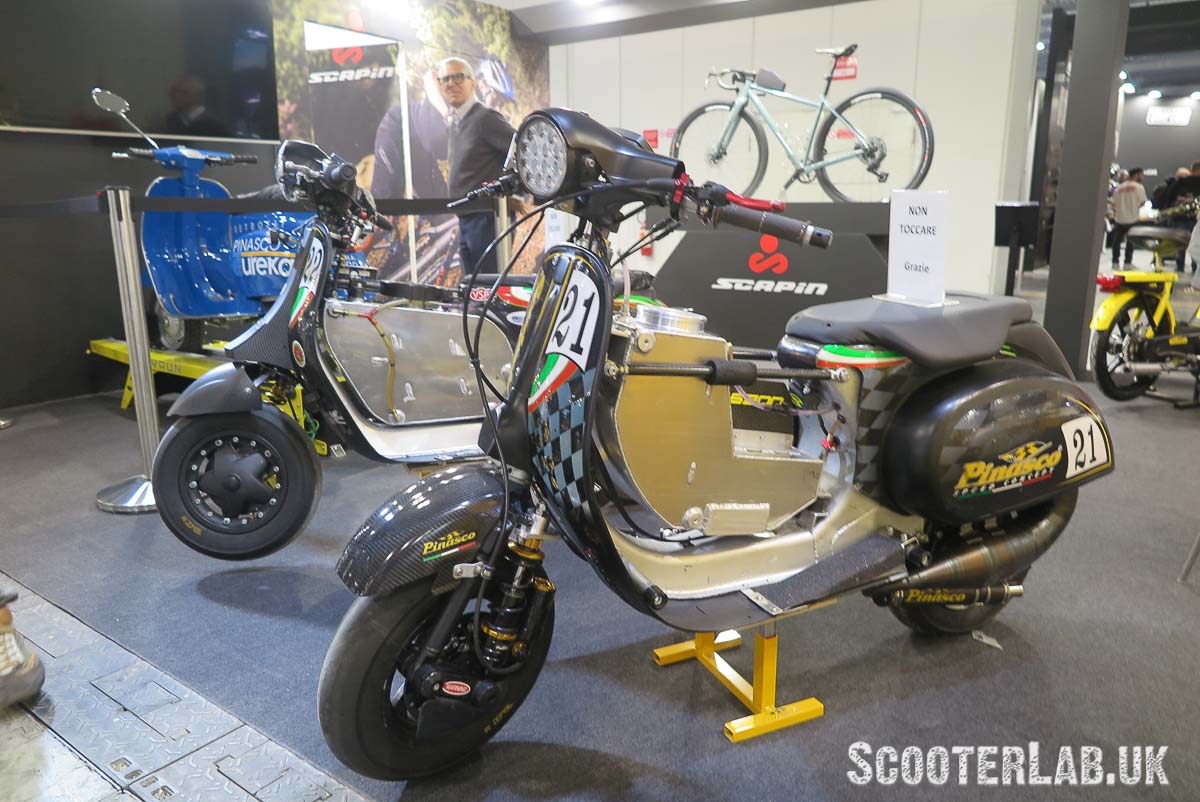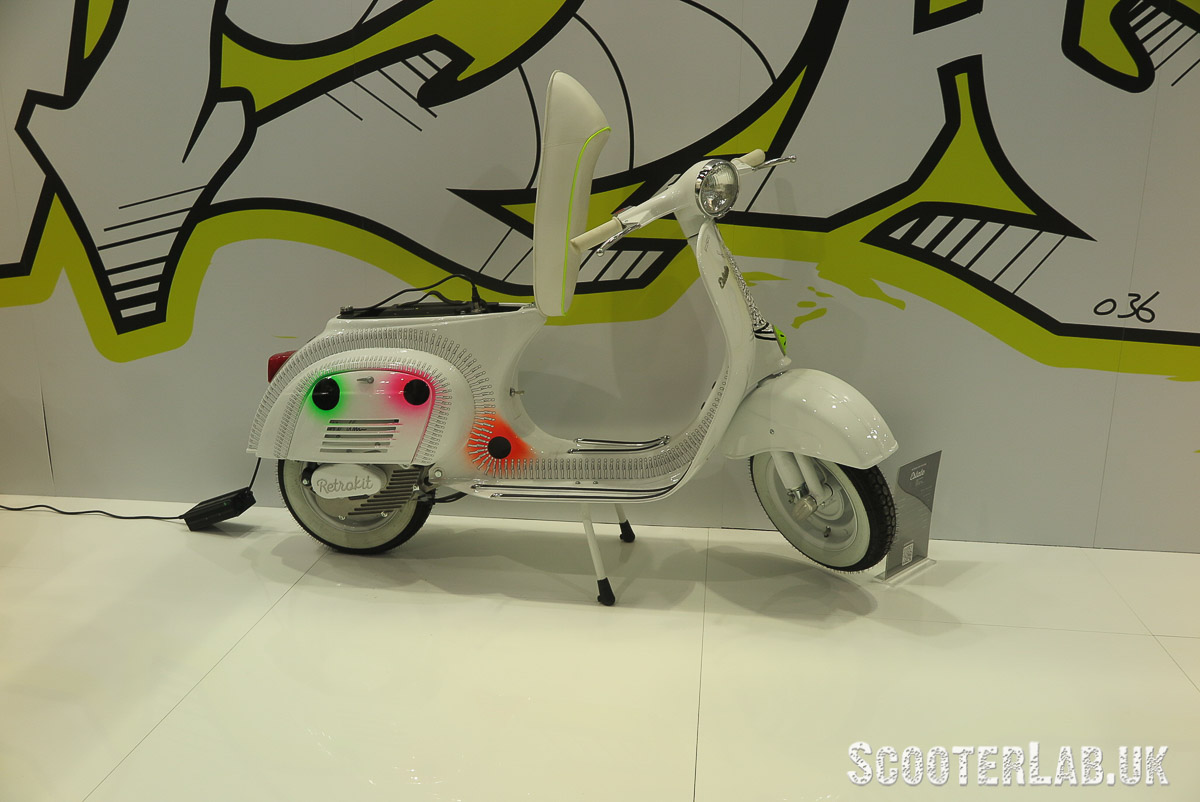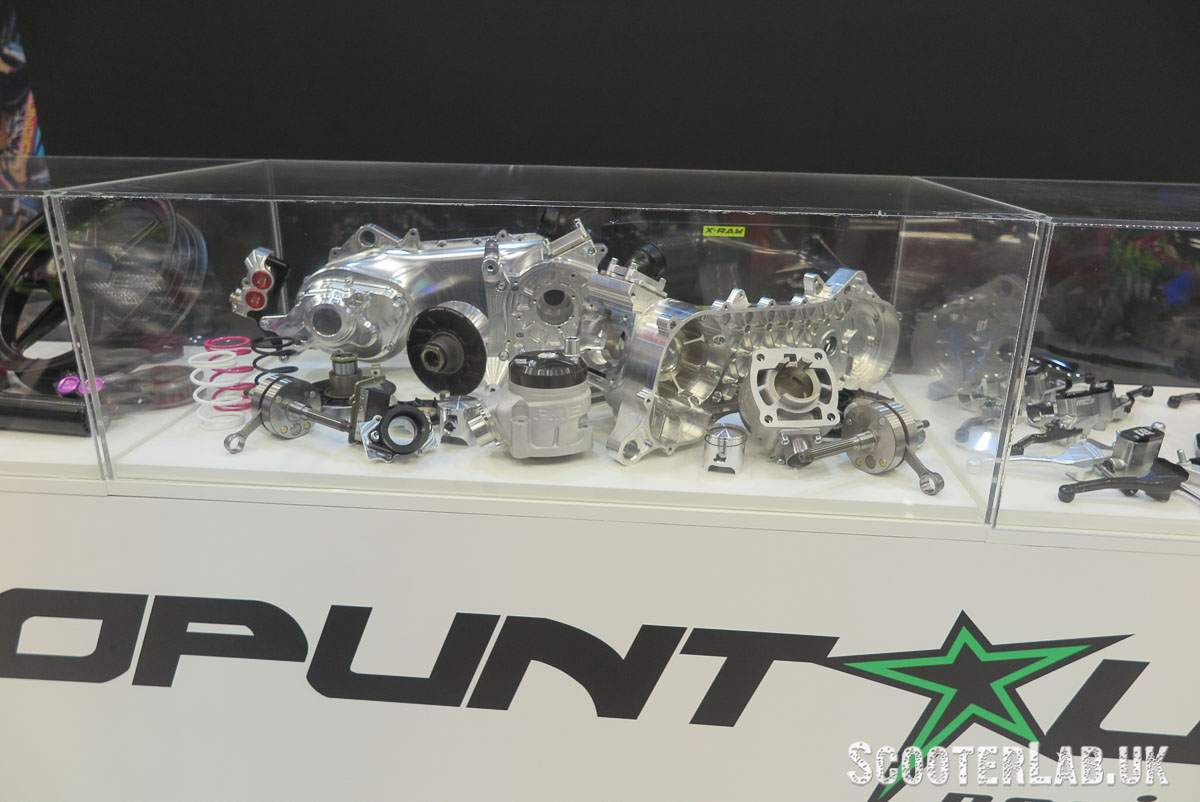
EICMA is THE best place to see all the new tuning parts from the main Italian companies. This year, we’ve compiled most of them into video presentations.
Sticky takes a look at the major mainstream players in both classic and modern scooter tuning, as well as people like NISA who specialise in quality Italian aftermarket and OEM seats.

The old boss
Although now retired, Andrea Pinasco was at the Pinasco stand, telling stories from yesteryear and showing off his new book, Andrea Pinasco, Segmenti (piston rings). The book is written in both English and Italian and will make a very interesting read for anybody with a passion for Vespas, or scooters in general.
Pinasco

Rear PX Disc conversion
Headline news from Pinasco is their new Vespa largeframe rear hydraulic disc brake. With Vespa tuning reaching new levels of power and performance, the rear brake is often the weak link. Right now, this conversion is for Pinasco engine casings, but they’re working on a retrofit solution for original casings.
The disc mounts onto the hub using extended wheel studs and an adaptor can be bolted on to support the rear 2-piston floating caliper.

Classic looks
Although not unique, the brake pump is mounted under the floorboards and is operated by the standard rear brake pedal. It’s a neat and effective solution that keeps the scooter looking pretty much standard.
Complete Pinasco engines?
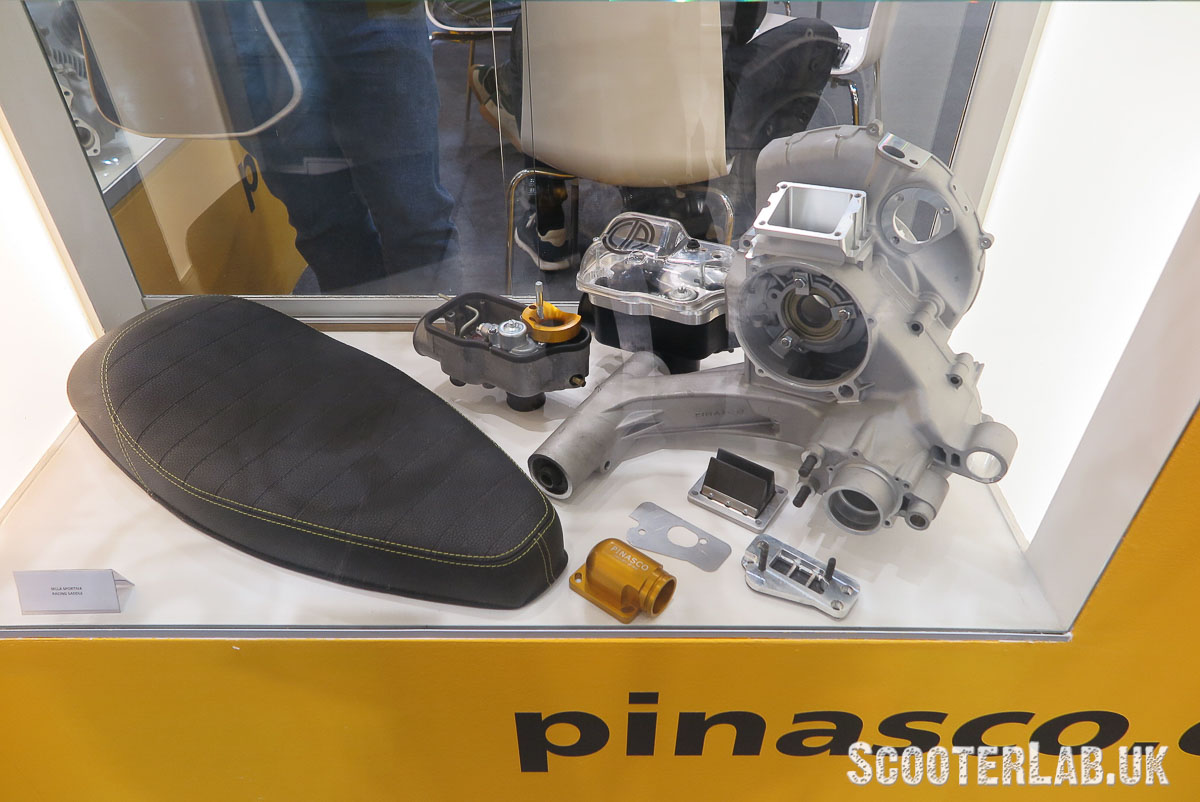
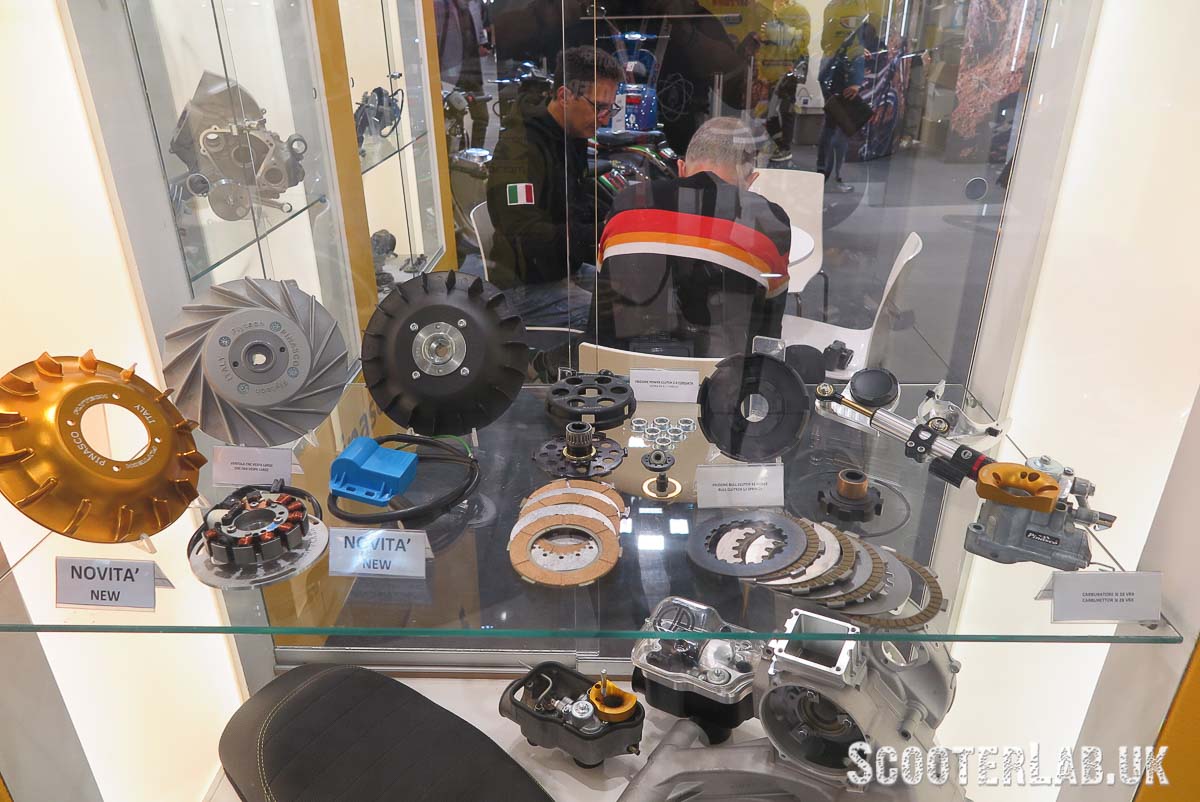
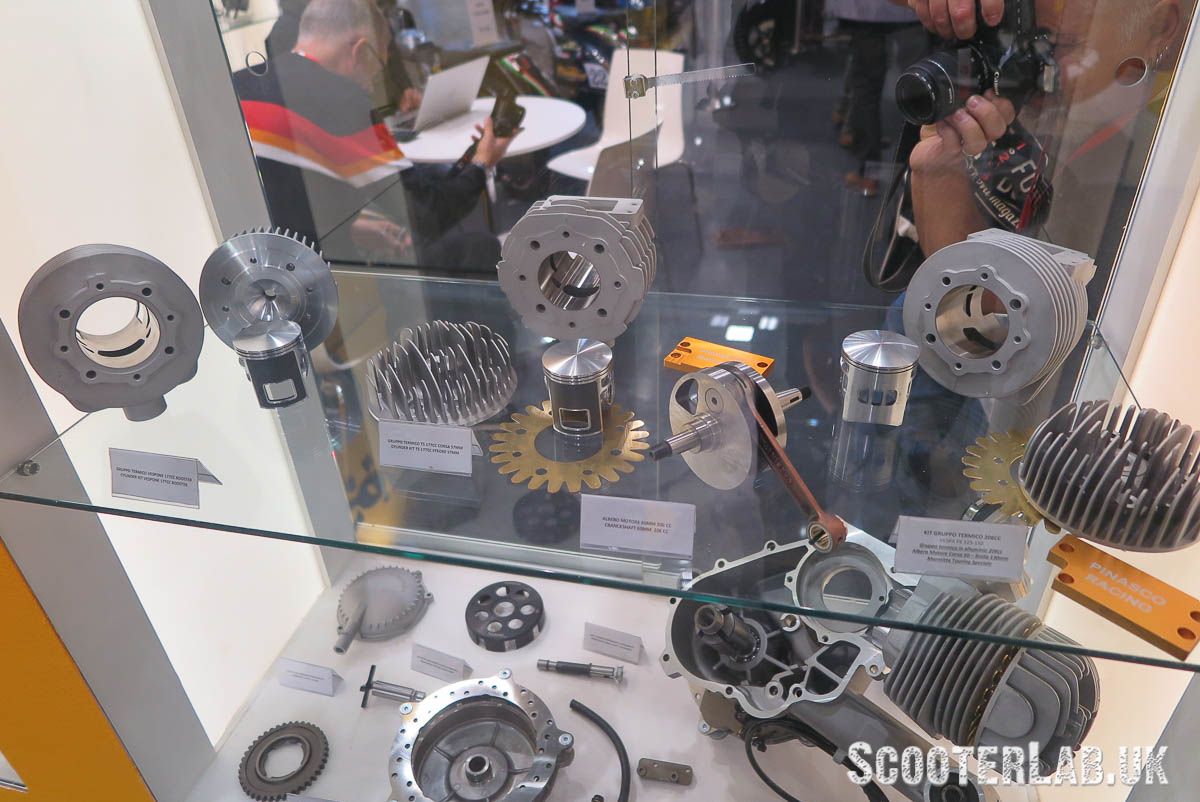
Having big power means items like the rear wheel output shaft can be troublesome, they’re prone to bending or snapping. Pinasco have upgraded their engine casing to support the shaft in a 3-bearing design. They’ve also improved the metallurgy of their shafts and gearboxes to cope with greater power outputs in the future. They’re also planning to supply complete ready-to-fit engines, which will be a great step for many classic Vespa owners.
VIDEO
Take a walk around the Pinasco stand with Sticky and Vittorio.
VMC

VMC
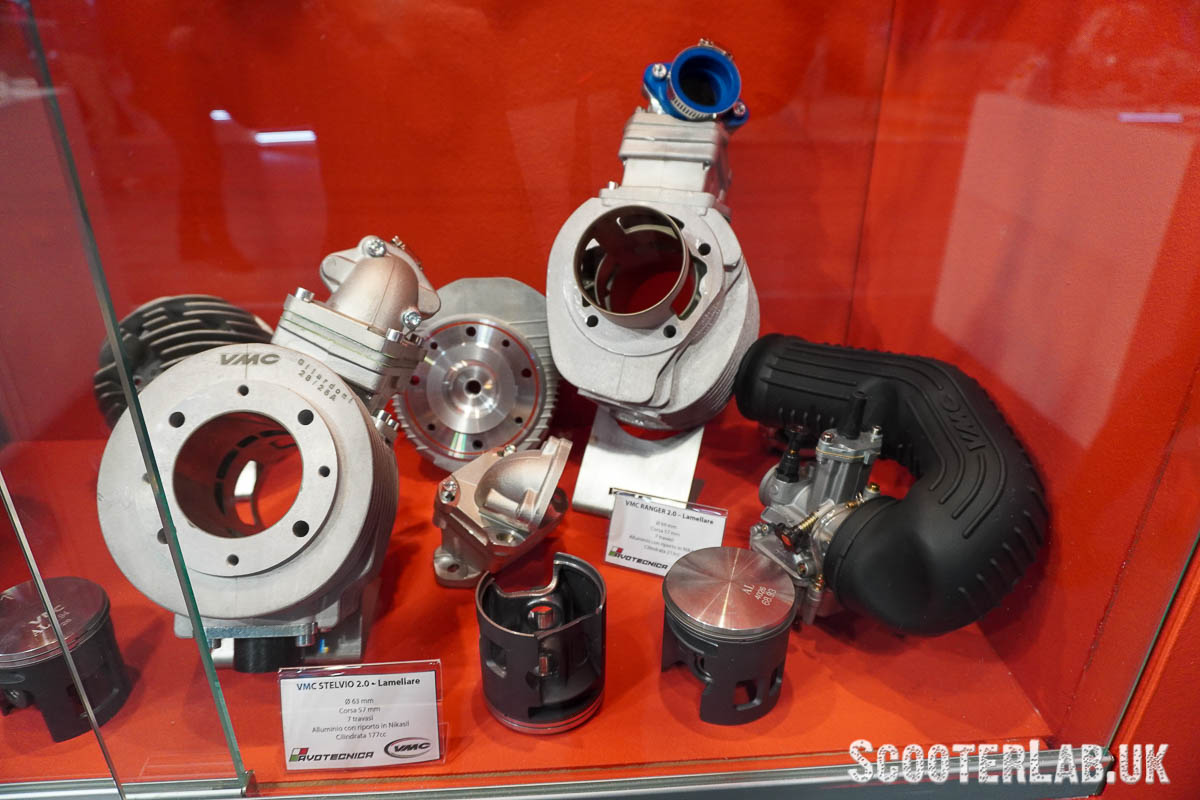
With no less than five new Vespa engine casings on display, VMC are expanding massively. They’ve also moved production of their casings closer to home. The casings on display were still in prototype form but are due to be on sale in 2027.
The VMC large-frame Vespa casings are designed to use an SI carb and airbox rather than a big-bore fuel-spitting petrol-muncher.

VMC Rotary Valve
This novel solution features a removable section, so if the sealing face gets damaged, it can be swapped out for a new one. It also means tuners can play about with the inlet port to suit the level of tune.

With the rotary valve removed, it leaves a massive hole where ordinarily Vespa tuners would fit a reedvalve and big carb. There’s no need for rthat though because VMC have a reedvalve casing especially for the job.

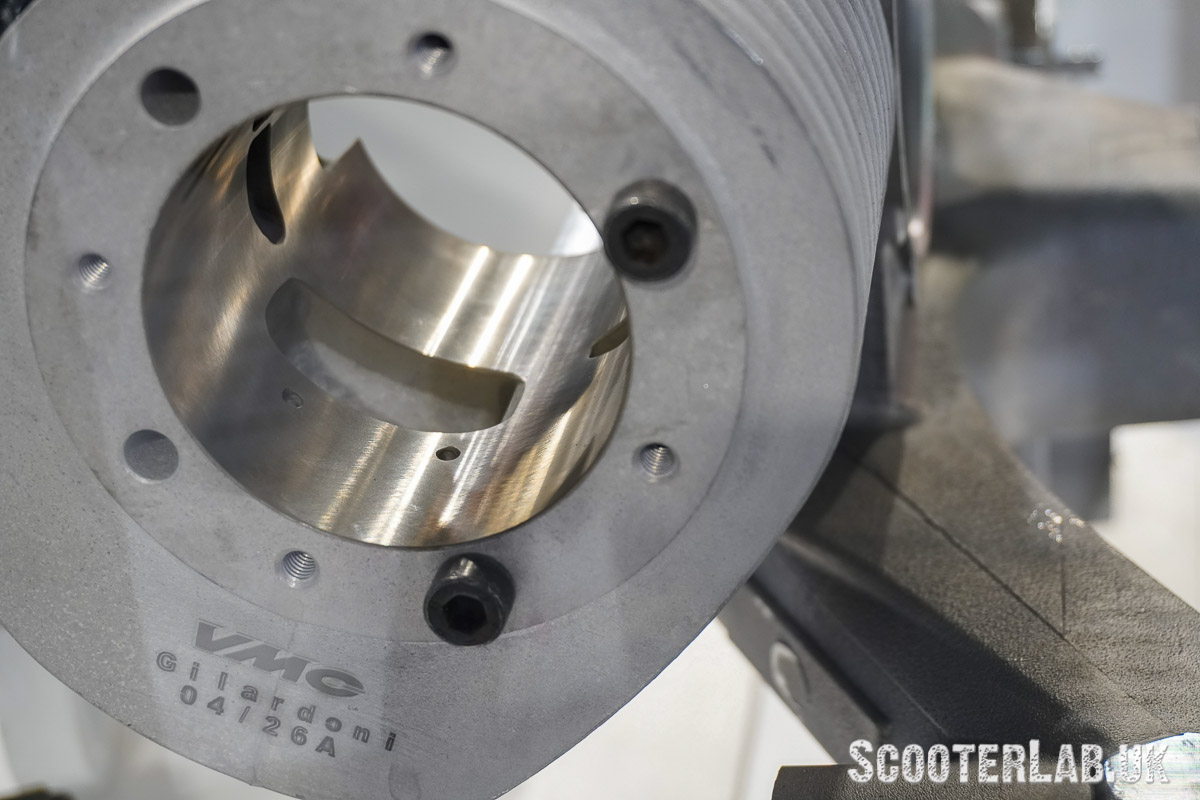
Instead of aiming inlet gasses directly at the obstruction of the crankwebs, VMC have produced a casing that takes gas from a forward-facing carb through an RD-sized reedblock (various rubbers are available to suit different carb sizes) and then forwards below the piston, completely avoiding the crankwebs.

Split inlet
The real novelty here, though, is that the incoming gas route is split into two channels that run around the outside of the cylinder studs (shown in red). They’re fed directly into the main transfer cutaways on the casing. Many of the new kits are spigotless, which creates a clear, efficient pathway for gas to enter the engine.
The VMC reedvalve casings use a ball-bearing on the flywheel side (like many rival solutions), where the VMC differs is that the casing is pre-bored to accept larger diameter crankshafts. This allows for an even longer stroke and larger-capacity engines.

VMC largeframe Vespa wheels and hubs
VMC’s one-piece cast tubeless wheels feature an extra-deep ‘well’ to aid fitting of tight tubeless tyres without damaging the inner bead of the tyre. At the rear, this rim is matched to a cast alloy hub specifically designed to bolt to SIP’s splined adaptor for 5-bolt automatic-style wheels.
This combo offers a more durable rear drum hub with a standard look.
Improved filler
All of the VMC largeframe casings also benefit from enlarged drain and filler plugs, which avoid the usual problems when trying to refill oil through a hole the size of a gnat’s penis.

VMC smallframe casings 2.0
For version 2.0 of the smallframe casings, the electric start mount has been dropped and extra material added around the gear cluster bearing. This allows them to be machined with a removable section to allow the complete gear cluster to be removed without stripping the engine. It’s not unique to VMC but makes life so much easier.
The casings will also be pre-bored at the casing mouth to allow fitment of kits with oversized spigots, such as those running 60mm pistons. They can also take larger diameter and wider crankshafts, making it much easier to build a large-capacity smallframe motor. The casting also includes space for two pins to mount a rear disc brake conversion.

Up front on the Vespa PX-style forks, VMC are offering two solutions. The first is a hub similar to the Grimeca-style cast hub. It has five pillars for the disc to mount to. The other is a standard-looking front hub that bolts onto a 5-bolt automatic front hub (ET4, for instance) and allows it to take normal-style Vespa or tubeless wheels. VMC’s disc conversion features a radially mounted 4-piston caliper.
Smallframe hydraulic conversion from VMC
With some smallframes pushing 100 bhp, the need for speed is coupled with the need to be able to stop! Their beautifully made forged front hub and fork link fit the traditional smallie forks and use a 4-piston radial-mounted calliper. These can also be fitted with quick-fit twist-lock brake hoses, a very handy thing to have when endurance racing.
We showed the neat master cylinder and lever set up at last year’s EICMA. It simply slides into the hole where your original front brake lever would go and bolts in using the single bolt. Simple but a very clever idea.
VIDEO
You can see and hear more about the VMC goodies (including largeframe kits) in the video above.
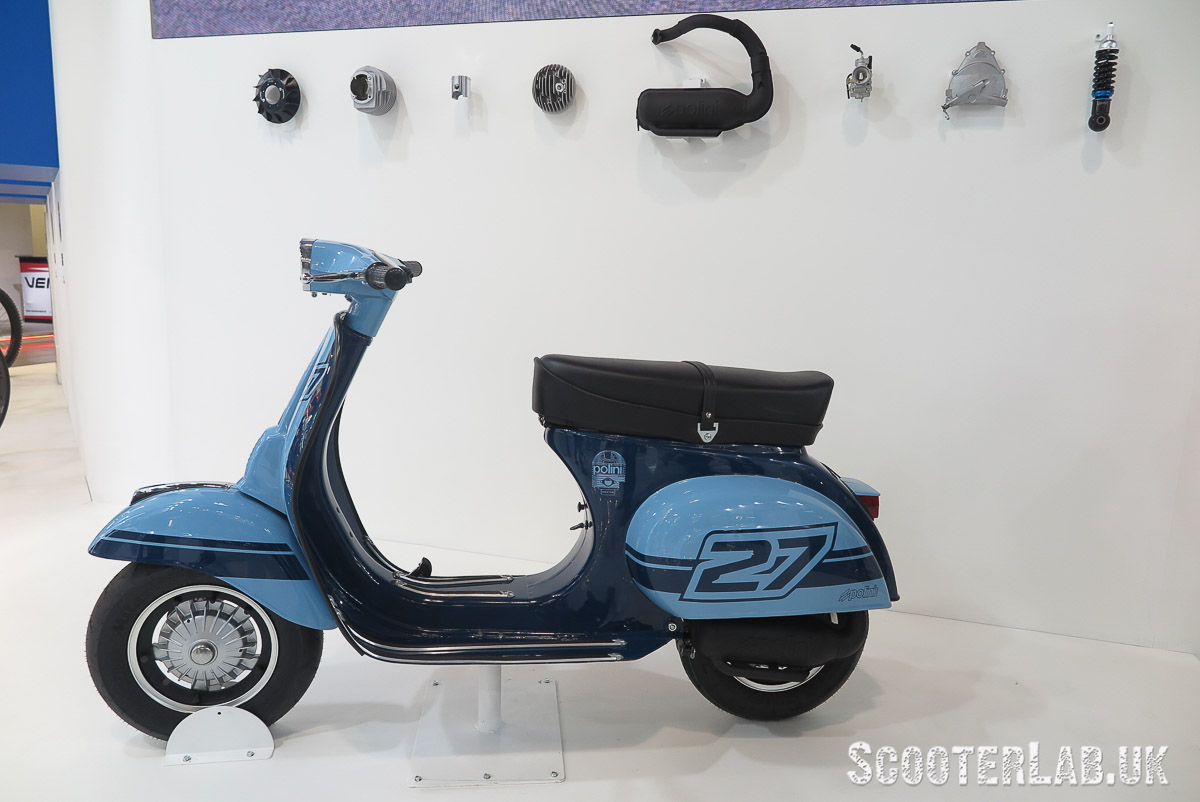
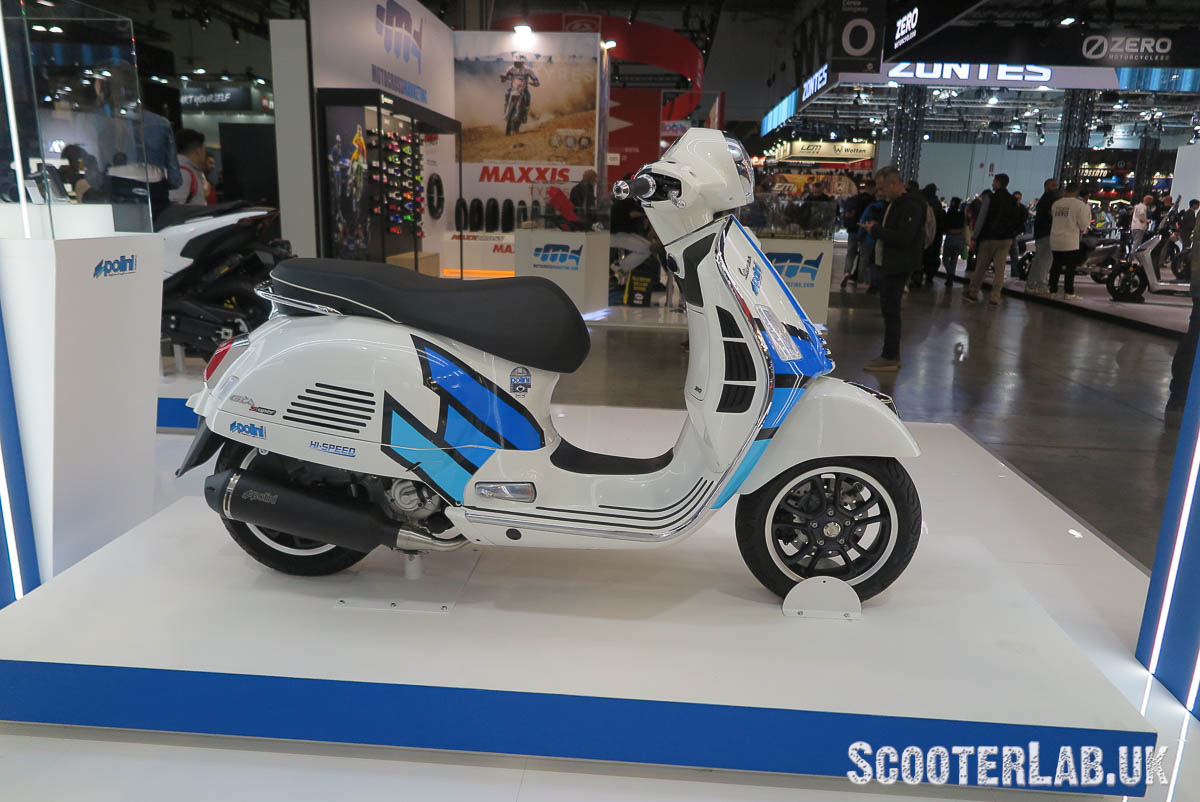
Polini

PX 244 kit
After competing successfully in the 24-hour Zuera endurance race, their new spigotless 244cc PX200 kit is already available to buy. The cast iron cylinder bucks the modern trend for alloy barrels, but it’s what they already use for their 208cc kits. Cast iron has some advantages (namely for reboring), but the engines need to be built and run-in properly. Correct jetting is critical, as is heat dissipation. If it can survive a 24-hour endurance race, a well-built cast-iron 244 kit should make a good rally engine.

Big crank
A dedicated 60mm crank is available for the 244 kit, with a super-long 127mm conrod. The splined crank fits their dedicated clutch and does away with the age-old woodruff key. A matching splined centre is required for the Polini HT clutch.
VIDEO
Polini show Sticky around some of their new products.
N.I.S.A. SEATS

N.I.S.A. Seats
Italian seat specialists, N.I.S.A, have recently bought Giuliari, producers of the famous Yankee Vespa seats (a rival to N.I.S.A’s own Camel line. They’ve developed a new Yankee seat for the Vespa GTS.

Classic replicas
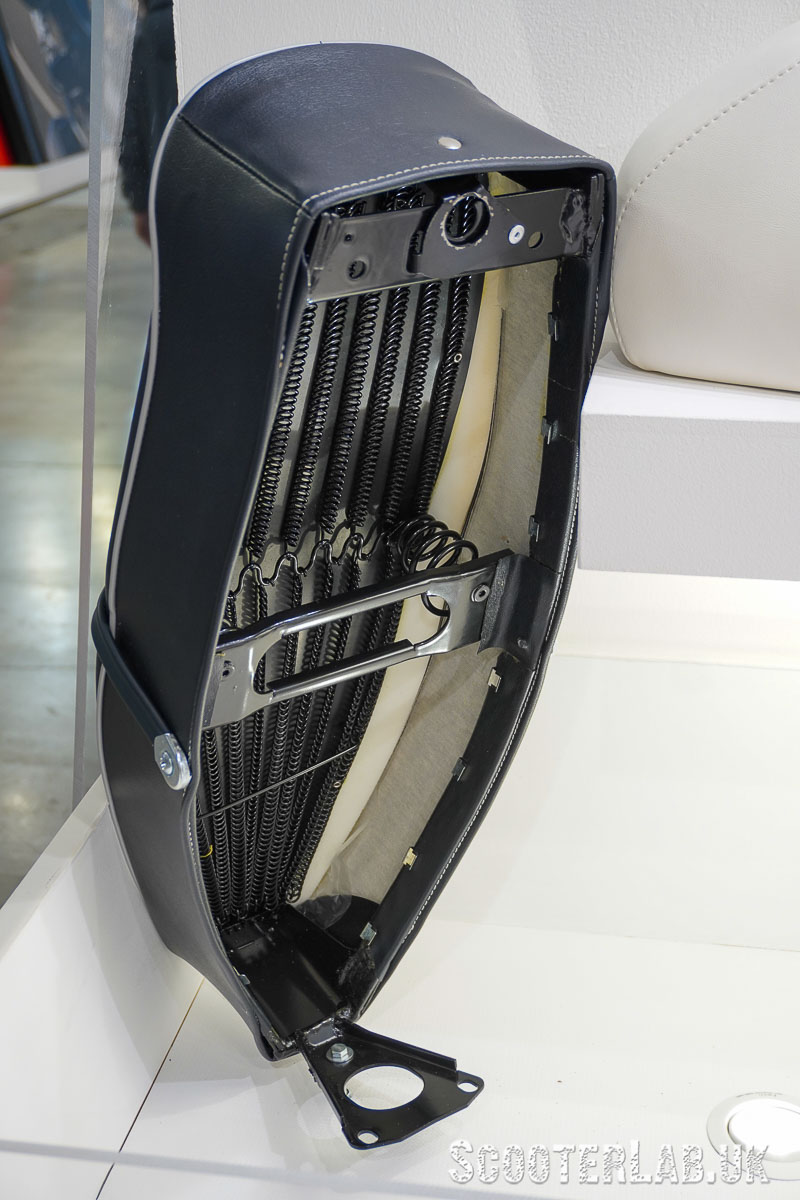
Classic Vespa riders will be pleased to see the N.I.S.A. replicas of seats for models like the GS160, SS90 and ET3. In looks they’re just like the originals but are constructed with foam internals for a more comfortable ride.
If you prefer the look and feel of a true replica, N.I.S.A. have made a full-on replica SS180 seat with correct spring positions, stitching and colours. They’re supplied in the UK through VE and their dealers.

Italjet touring seat
N.I.S.A are the official OEM producer of Italjet seats and have recently launched their roomier Touring Seat for the Dragster 125/200/300. Available in plain black, Gresini and Malossi colours, the seats will be available to order from Italjet UK in the next week or two.
VIDEO
Take a look around the N.I.S.A. stand.
MALOSSI
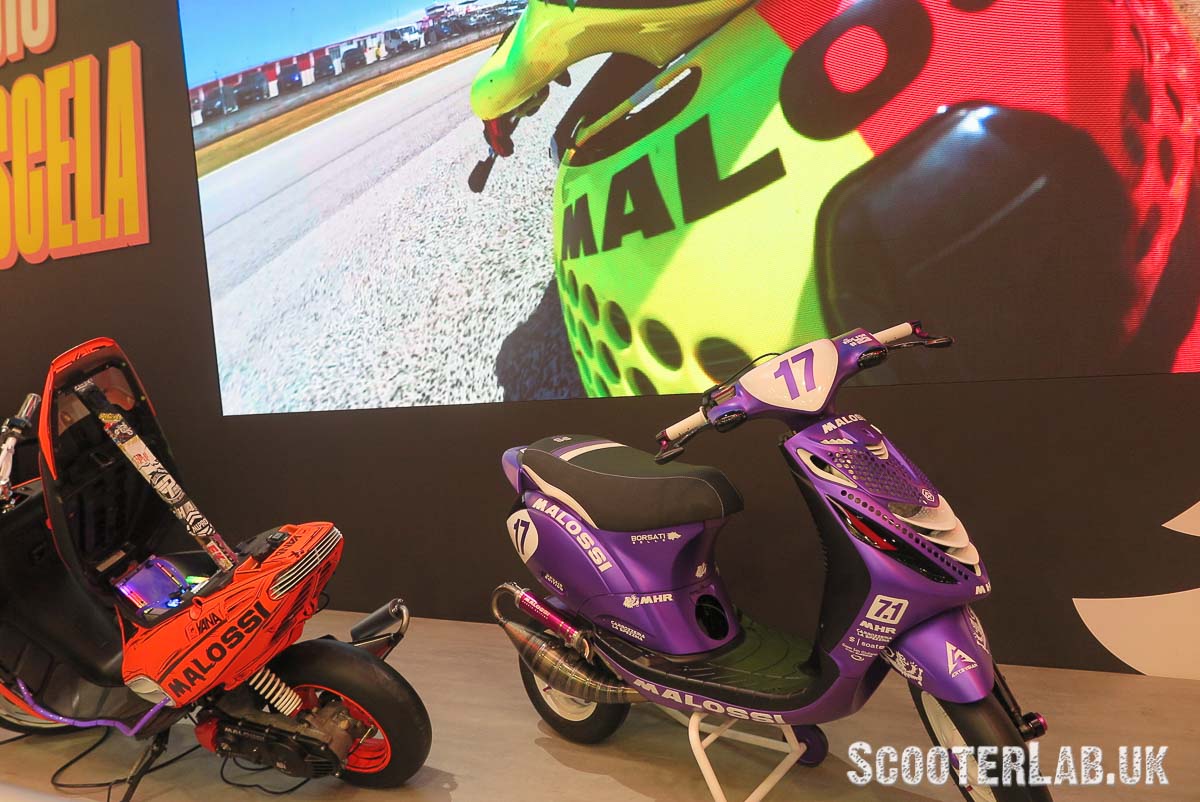
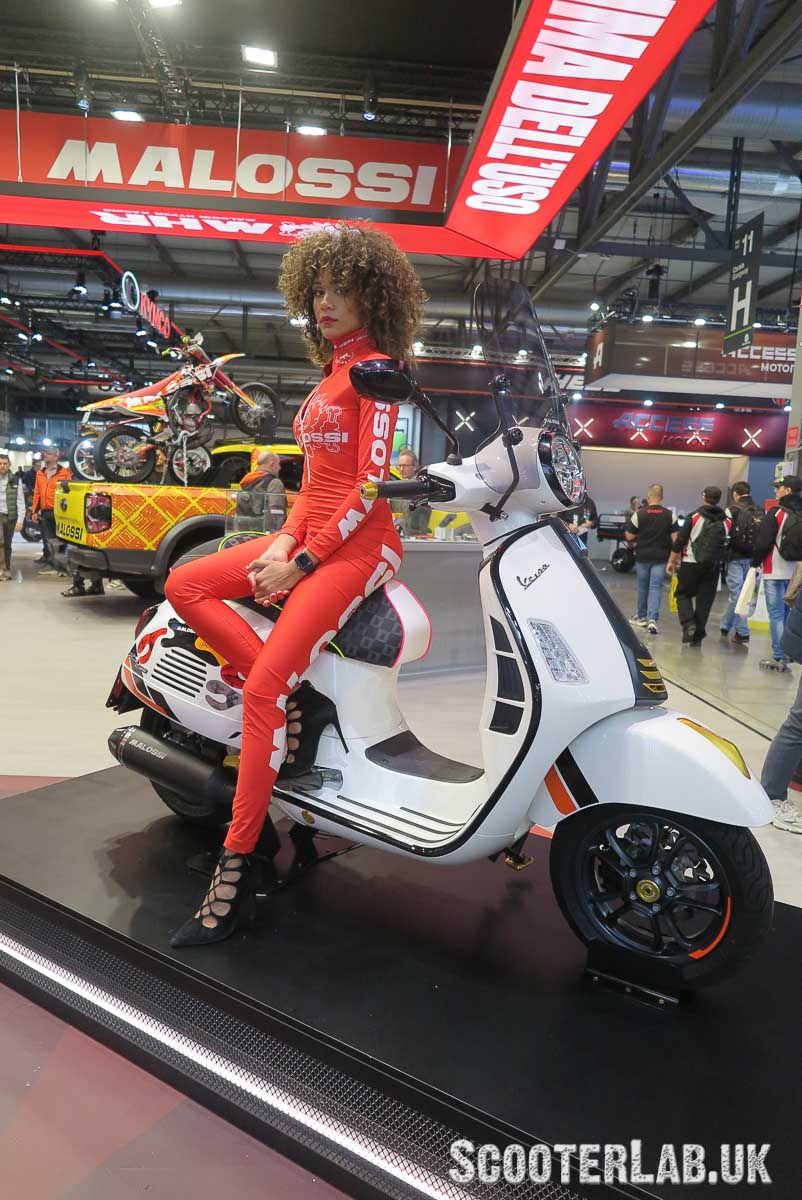
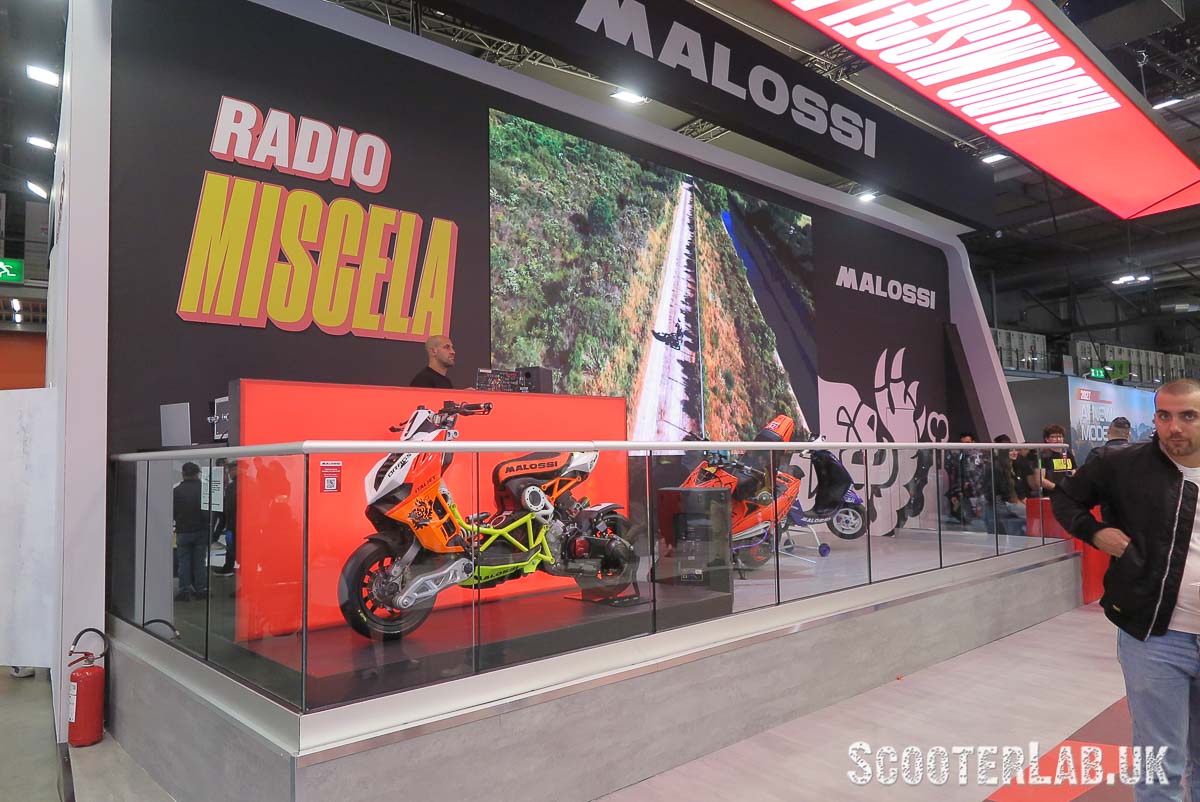
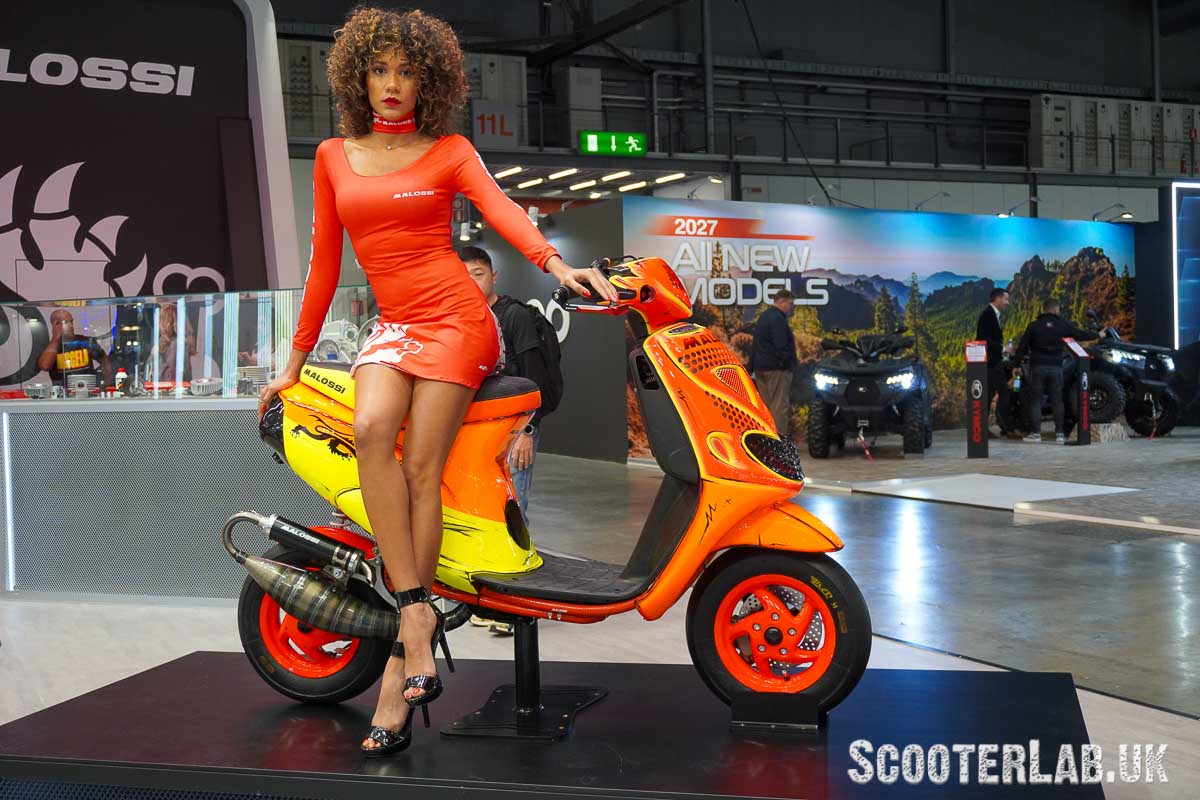
It’s not easy to get information out of Malossi, but Sticky tried his best. In the video above, we find out about their new, improved Vespa gearbox, as well as parts for modern autos, including a new cylinder for the Vespa GTS 310.


Gallery
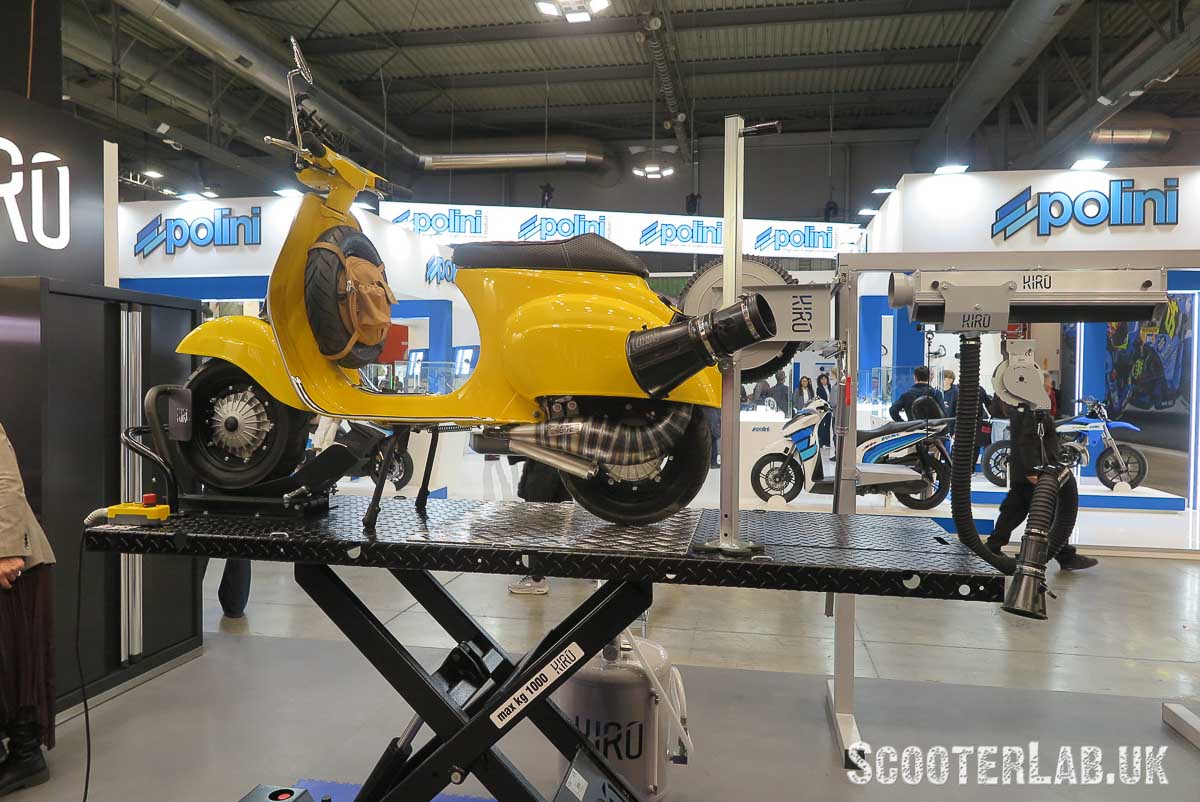
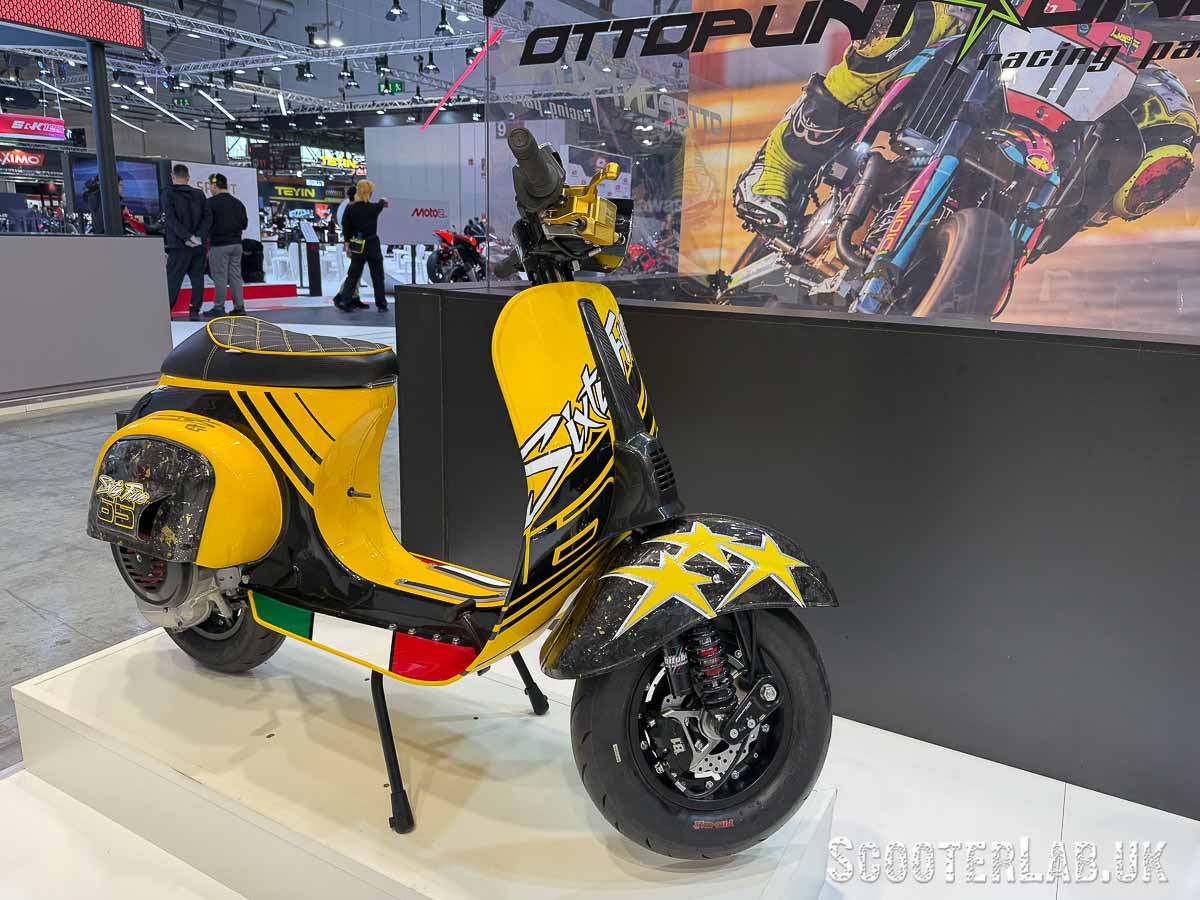
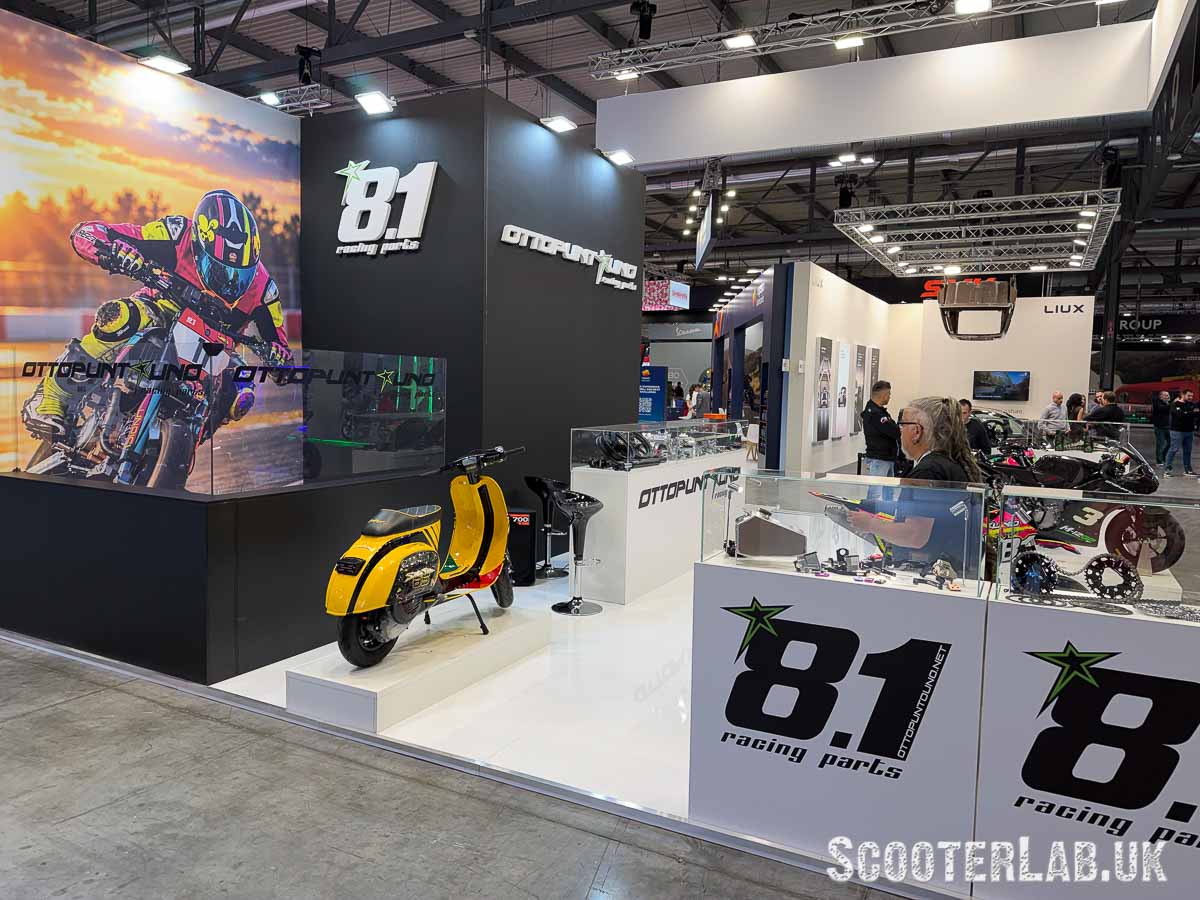
In the gallery above, you can find a few more images from around the show, including Loris Cappirossi’s #65 Vespa smallframe on the Ottopuntuno 8.1 stand. If you want to get more information on some of the products we’ve featured, the next issue (49) of ScooterNova magazine will be able to answer your questions.
Thanks to Sticky for the videos and most of the images i n this feature.